Showing posts with label D'Artagnan. Show all posts

Friday, January 21, 2011

Castles, France and Chestnut Lentil Soup


It’s cold and damp.  The snow has been around since Christmas and I am ensconced on my sofa, still chilled through and through but with a head full of warm daydreams --  escaping the drear in spirit if not body. 

 
 Joseph Canteloube 1879 -1957
*           
It happens every time I listen to Joseph Cantaloube’s Chants d’Auvergne (my favorites are Brezairola and Pastorelle -- you can listen here: Canteloube: Chants d'Auvergne). It is truly transporting music from a composer who reverenced the songs of his homeland at France’s wild center, the Auvergne (which takes its name from the ancient Gallic tribe, Arverni, defeated by the Romans nearly 2000 years ago).  He collected the songs in the last 30 years of his life and the result is pure enchantment and so evocative of the place and Cantaloube’s love for it… you can feel his heart’s pulse in every note. It sets me to dream of France.

*           
The Auvergne lies on the eastern side of an area known for incredible beauty and spectacular food going to the Dordogne and the Southwest -- places that rival Paris for sheer numbers of historical sites (including one of my favorites -- the 17,300 year-old cave paintings at Lascaux near Montignac).


Thanks to Anita for telling me about the underground majesty of Gouffre de Padirac... surely there must be a fairy kingdom somewhere in it's dark miles of streams and caverns.  For purposes of my daydream… I know you will forgive my vague, inclusive geography, won’t you??

Chateau de Montbrun, Limousin (Brangelina looked at it, since it’s for sale for € 24 million)   

 Its castles (from the Latin castellum) are right out of dreams as well… they are the kind of turreted beauties with crenellations and pointed roofs that all fairy princesses call home.


The land around these castles is wild and fiercely beautiful --with the Auvergne mountains -- the Central and Eastern Massif Central and


the Western Massif Central--the source of the Dordogne river.  There is the vast, game-filled forest of Tronçais (home of the oak that makes limousin wine barrels for the finest vintages in the world),


Sioule River


and the river Sioule and the river Cher winding their way through the unspoiled forest.


Guery Lake


The Guéry, Servières and Pavin Lakes surround Le Sancy and the 80 dormant volcanos of the 25 mile long Chaîne des Puys (the highest being the Puy de Dôme provide drama and striking vistas for the region (Puy is the French word for volcanic summit from which the famous lentils take their name and get their fine taste from the volcanic soil).


Puy de Dôme    

But it is those magical castles


and  medieval villages


that keep my mind wandering there… wishing to be whisked from my snowbound doldrums into the never-never land of magical places where (in my imagination) it is forever temperate with sweet scented air… in a proper fairytale sort of way (guess you know where I want to take my vacation!).

Ah well, I can’t snap my fingers and materialize one of these castles like a sorceress, but I can conjure some magic for your kitchen. 


I had the recipe equivalent of a pleasant earworm thanks to a description of a soup that Diane at 2 Stews  had at La Régalade in Paris a few months ago.  She said it was a chestnut soup poured over a symphony of favorite flavors –– foie gras, cheese and chives (and I thought I saw croutons?). I set about to recreate it. Chestnut soup is a renowned specialty of the Auvergne region lush with famous forests full of chestnuts and game and nearby the epicenter of foie gras in Périgord (although Périgord now processes  IMPORTED raw materials from Eastern Europe and Israel as the properly raised local product cannot keep up with demand!)  I decided to use a version with a bit of game to it as they often do in the region and chose a cheese like an Auvergne product, Saint Nectaire --  a semi-soft, nutty-tasting, washed-rind cheese.

The recipe from La Régalade (via Gourmet Magazine) served as the basis for the “velvety emulsion” (the voluptuous Nigella Lawson makes a similar soup  you can watch HERE from The Caprice in London as well—sans foie gras), but I also took inspiration from some traditional Auvergne recipes.
The duck fat, smoked duck breast, chestnuts and foie gras come from D’Artagnan and there are links to order them.


Chestnut & Lentil Soup, inspired by foods of the Auvergne and La Régalade, serves 6


½ cup duck fat  
2 T butter
4 slices bread, cut into croutons (around 3 cups)
½ pound vacuum-packed chestnuts (or 1 ½ c cooked peeled chestnuts) 
3 T armagnac
1 smoked duck breast, skin removed, sliced thinly (around 7 oz) 
1 shallot, peeled and sliced
¼ c chopped onion
1 small celery root (7 oz), peeled and cubed
1 carrot (7 oz), peeled and cubed
4 sprigs thyme
4 sprigs parsley
2 bay leaves
1 c lentilles de Puy or French green lentils
8 c cold water
1 t salt
1/3  c heavy cream
3 ½ oz foie gras, cubed (if you can’t spring for the foie gras… try a  good creamy foie gras mousse) 
2 oz soft cheese, cubed (like a St. Nectaire from the Auvergne—I used Morbier but a brie type cheese would work too… sliced thinly to melt)
chopped herbs for garnish (few sprigs parsley and thyme & chives)

Slice and soak the chestnuts in the Armagnac for a few hours.

Heat 4 T duck fat and 2 T butter and sauté the croutons till crisp and golden and reserve.

Sauté the thinly sliced duck skin in the 2 T duck fat till crisp and reserve.  Sauté the shallot, onion, celery root and carrot in the same duck fat.

Make a bundle of the herbs and toss into the pot.  Add the lentils, 1/3 of the smoked duck in 3 big chunks and chestnuts, reserving the Armagnac.  Add the water and salt and cook 20-25 minutes until the lentils are soft.  Strain the soup, reserving most of the cooking liquid, and remove the herbs and the duck.  Puree the soup using the reserved cooking liquid as necessary and the heavy cream.   It will be creamier if you start with a small amount of liquid so that it can really be pureed. Add the reserved armagnac to taste.  The soup will thicken as it stands so keep the cooking liquid to add as needed.

Sauté the  reserved smoked duck in remaining 2 T duck fat, remove and keep warm.  Saute the foie gras gently to warm.

Put croutons, sliced duck, cheese and foie gras and herbs in bottom of soup bowl.  Pour hot soup over all and serve immediately

* I can imagine doing this vegetarian would be great. substitute a nut oil like hazelnut for the duck fat and skip the meat component.


Thanks to Gollum for hosting Foodie Friday!

Thursday, January 6, 2011

Cassoulet


Those of you who read Lostpastremembered regularly know that I love my neighbors at D’Artagnan  (yes, that means you Lily Hodge and Katie Holler!).  They have been my salvation for a million necessary delights to do wild and esoteric antique game dishes.  One of the many perks of this relationship is leftovers.  After I made pheasant under glass, I had most of the rest of a pheasant ready to throw into something.  Given Ariane Daguin’s (founder of D’Artagnan)  Gascon heritage, it seemed only fair to use my bounty to make one of my favorite dishes for winter -- cassoulet! I got a few confit duck legs from them, some duck fat and wild boar sausage added ham shank and made a spectacular cassoulet…. the second of the season (ok, I love cassoulet and the first went so fast… it was inhaled by the male diners!).  The best part about cassoulet is that you can play with the ingredients and add different sausages or meats and make the dish your own.

May I add, should you want to get all of the makings for a cassoulet in one gorgeous package, D’Artagnan is featuring their Cassoulet Recipe Kit  at a reduced price till Jan 10, 2011 to celebrate National Bean Day (Jan 6)…it’s an insanely great deal!   

Of course,  I couldn’t write about cassoulet without a little bit of history, could I????  Jeff Iverson  at Time Magazine wrote a whole article about it because, well, let’s face it -- the dish has both fascinating roots and rabid partisans.  There are as many recipes for the dish as inhabitants of the Languedoc, I reckon.  D’Artagnan founder Ariane Daguin’s dad, the famous chef Andre Daguin, has a spectacular version that is in Paula Wolfert’s book,  The Cooking of Southwest France : Recipes from France's Magnificent Rustic Cuisine

It is made with fava beans instead of the tarbais white bean that is today’s classic bean for the dish.  I am dying to make it in spring when the fava beans return-- I read favas were the original bean component of the dish as the tarbais style bean didn’t arrive from South America till the 16th century – in fact, it was called fevolade before it was cassoulet!). 

Iverson said: “Natives of southwestern France's Languedoc region link their very cultural identity to the archetypical peasant dish, a rich, earthy casserole of beans, meat and herbs. Cassoulet is said to date back to the 14th century siege of Castelnaudary during the Hundred Years' War, when citizens created a communal dish so hearty their revivified soldiers sent the invaders packing. But since then several cities have laid claim to the true recipe.”

Michael Balter in an article in the more familiar territory of Saveur Magazine said: “Traditionally, each of these towns has its own version of the dish, though it is generally acknowledged that cassoulet had its beginnings in Castelnaudary."


"Convention has it that the cassoulet of Castelnaudary is based largely on pork and pork rind, sausage, and (sometimes) goose; the Carcassonne variety contains leg of mutton and (occasionally) partridge; and the cassoulet of Toulouse includes fresh lard, mutton, local Toulouse sausage, and duck or goose. Prosper Montagné, a celebrated turn-of-the-century French chef, wrote that cassoulet was the "God" of Occitan—southern French—cuisine, with three incarnations: "God the Father, which is the cassoulet of Castelnaudary; God the Son, which is that of Carcassonne; and the Holy Spirit, which is that of Toulouse."  Prosper was very diplomatic, but his descriptions really make me want to try them all!

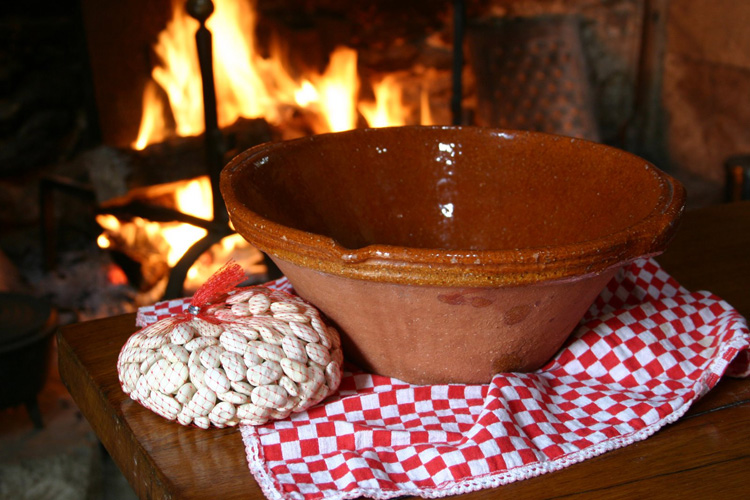
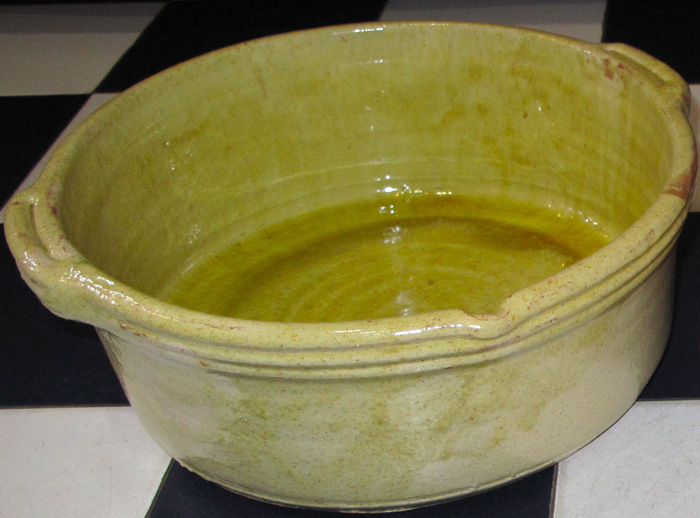
Although I admit to making my cassoulet in a giant vintage Dru pot (Julia Child used them on her older shows… blue with little tulips on the side), supposedly the true cassoulet cannot be achieved without a cassole.

The idea of the dish is simple, a wider mouth allows for more surface area for the brown crusty top, and the spout allows you to pour off any superfluous fat that may have accumulated.  The king of cassole makers is Poterie Not Frères near the village of Mas-Saintes-Puelles.  They make them with Issel clay in an oven that was built in 1830. The cassole was first made in Issel, a village north of Castelnaudary hundreds of years ago.


Poterie Not Frères pottery photo from Kate Hill

Now the Not family are the only remaining artisanal manufacturers of cassoles in the area and the magnificent Kate Hill of Camont: Kate Hill's Gascon Kitchen recommends and uses them for her weekend cassoulet class in France (you can find out how to do that HERE). I can only imagine how much fun that would be.


Kate also sells these beauties at her place in Gascony, France should you be in the neighborhood.  You can get a small version of them in the USA online HERE (unfortunately, they are out of stock at the moment!) .


or stop in at the charming shop, La Fanion in NYC (if you are in my neck of the woods)  to pick up a slightly less tapered version (they go from $78-$198 for a giant feed-an-army size). There is an American made version (to Wolfert's specs) HERE. Whatever you choose as a vessel for your cassoulet, it is all about the flavor and that is in this recipe in spades!

Jean-Claude Rodriguez, founder of Académie Universelle du Cassoulet (a group of chefs dedicated to keeping up cassoulet standards) told Iverson "Cassoulet has such a religion around it because it's the plat de partage — the dish of sharing," he says. "When a cassoulet arrives at the table, bubbling with aromas, something magical happens — it's Communion around a dish."  


My Favorite Cassoulet,  serves 6-8

1/3 pound smoked ham, cut into chunks  (if no ham shank, use 1 pound of ham)
1 smoked ham shank from Flying Pigs Farm 
1 pound of dry tarbais beans, cooked thoroughly or 3 cans cannellini beans, drained and rinsed
2 pieces good smoky bacon, roughly chopped
1 large carrot
1 medium onion, diced
1 leek
1/2 head of garlic, sliced plus 2 small garlic cloves, peeled and pressed
3 T tomato paste
1 quart chicken broth (plus one cup if cassoulet gets too thick)
sprig of thyme, sage and rosemary and marjoram if your can get it
4 D'Artagnan duck confit legs (or 2 with 2 pheasant legs)
1 lb wild boar sausage, skinned, sliced  (although it is traditionally made with French Garlic Sausage
2 T butter
1 ½ - 2 cups fresh breadcrumbs (depending on the diameter of your dish you may want more or less)

*Bread crumbs are optional... some purists do not use breadcrumbs and prefer the darkened crust that forms on the top, breaking it while cooking so that more will form.

Sauté the bacon, add the vegetables, garlic and the duck fat and cook for a few moments.   Add tomato and cook, stirring, for 1 minute. Add 1quart broth & herbs, beans and ham and shank.  Cover the casserole and gently simmer the ragout over low heat for 1 hour, stirring occasionally.
Preheat the oven to 300°.
Remove the skin from the pheasant and duck legs and reduce all skin and fat to crisps and put the crisps to the side.  Shred the duck meat and add to the pot.  Save the fat in the pan.
Add the sausages and cook over moderately high heat until browned all over and add to the pot. Cook for 1½ hours. Take the meat off the ham bone and return to the pot.
Gently stir the cassoulet.  If it seems too thick, add the extra stock.  You can add the skin crisps now or save them to serve with the cassoulet.  Take the breadcrumbs and crushed garlic and toss in the reserved duck fat.  Add 2 T butter to the mix.  Sprinkle the breadcrumbs on the surface of the cassoulet. Bake the cassoulet for 1 ½ hours longer, until it is richly browned on the surface. Ariane Daguin recommends serving it bubbling hot for the best flavor. and aroma.


Thanks to Gollum for hosting Foodie Friday!!

Friday, September 24, 2010

Eliza Acton’s “Saunders”, Mashed Potato and Sausage Comfort Food


One of the reasons I have enjoyed meeting food lovers from other countries is that they have expanded my cooking universe exponentially. I have learned about so many new writers and cookbooks that had before only been vaguely recognized names or were completely unknown to me.


1845 Version of Modern Cookery


One of these new figures is Eliza Acton. A food historian I met is writing a biography about her and told me she was a remarkable figure. When I read Acton’s cookbook, I realized what all the fuss was about. About her personally, little is known outside a few facts. As far as I can tell, there are no photographs of Acton, at least none I could find. Aside from Wikipedia, the Tonbridge Historical Society has the most information available on Acton who was one of its famous citizens (I can’t wait for that biography!).

Eliza Acton was the first modern British cookbook writer and she sold 60,000 copies through 40 editions of her 1845 Modern Cookery in All Its Branches: Reduced to a System of Easy Practice, for the Use of Private Families : In a Series of Receipts, Which Have Been Strictly ... : To Which Are Added Directions for Carving, long before the better-known Mrs. Beeton’s 1861 Mrs Beeton's Book of Household Management (Oxford World's Classics) (Mrs. Beeton’s book sold a million copies!). This didn’t stop Mrs. Beeton from purloining 150 of Eliza’s recipes for her book without giving Acton credit. Eliza wrote of this in a later edition of Modern Cookery for Private Families, “At the risk of appearing extremely egotistic, I have appended “Author’s Receipt” and “Author’s Original Receipt” to many of the contents of the following pages: but I have done it solely in self-defense, in consequence of the unscrupulous manner in which large portions of my volume have been appropriated by contemporary authors, without the slightest acknowledgement of the source from which they have been derived…. I am suffering at present too severe a penalty for the over-exertion entailed on me by the plan which I adopted for the work, longer to see with perfect composure strangers coolly taking the credit and the profits of my toil.”


The facts, such as they are, are these: Eliza Acton was born in 1799 in Battle, England. She didn’t come from a wealthy family, being the daughter of a brewer and Eliza left Battle to grow up in Ipswich where she ran a school for girls for 4 years to pay her way in the world. After an illness she spent time in France (where there was perhaps an unhappy love affair) before moving to Tonbridge, Kent where she lived with her siblings and her mother who took in borders to make ends meet. There she stayed (although by 1841 she was alone in the house) until after her cookbook was published at which point she moved to London where she remained until her death in 1859.

Eliza began her career in writing with poetry. She is a romantic poet and old fashioned to modern ears. Her book of poetry entitled simply, Poems, was published in 1826. I will share one of them with you… like many in her book, it speaks of lost love, pain and thwarted dreams which sadly may have been Acton’s life:


ON SEEING A ROSE IN A GLASS OF WATER, WITH THE MOTTO,
"Je vis,--mais dans les larmes!"
Such is the heart whose treasur'd store

Of sweet, and early hope is gone:

It withers to revive no more,

Or lives, like thee, in tears alone!

Although well received, it was not a big seller, and her publisher advised her to do a cookery book to increase her income. She realized that there was a dearth of books for novice, middle-class cooks without a covey of servants to take care of them and decided to fill that niche with clearly written recipes and instructions on how to do pretty much anything in the kitchen. Hers was the first kitchen basics book and the first cookery book to list ingredients. Best selling British cook book writer, Delia Smith, said that Acton was “the best writer of recipes in the English language.”

Some of the recipes are named for familiar things in Tonbridge, like a cake named for the street Acton lived on (Bordyke Veal Cake) and some referenced people she admired like Baron Liebig who wrote that bad cooking wasted food (Bavarian Brown Bread). She often gives generous credit for recipes that were given to her by others.


Acton wrote her final book in London in 1857 The English Bread-book that was a history of “panification” (bread-making) as well as many fine recipes. But it also “contained Acton’s strong opinions about adulterated and processed food.” The titles of the first and second chapters tell it all:

CHAPTER I

Bread—Its Value—Its Wholesomeness—Its faulty Fabrication here – The Waste of it—The Necessity for a more general Knowledge of the Mode of Preparing it—

CHAPTER II

Government Investigation of Commercial Frauds—Beautiful adaptation of Pure Bread to the Wants of Man—Grievous Social Wrong of Adulteration…Chemical and Medical Testimony to the injurious effects of Alum --


Well, you get the idea! She was really a pioneer in the movement against over-processing and urged homemakers to make good healthy loaves (she made them in crocks not tins) for their family. It’s a fascinating read. Like many authors of the day, Acton also wrote for periodicals, in her case for The Ladies Companion and Charles Dicken’s Household Words (she named a recipe for one of his characters from Martin Chuzzelwit – “Ruth Pinch’s Beefsteak Puddings, a la Dickens” and wrote to tell him so in 1845). Today she is known for her recipes, as well she should be.


I know better than most that historic recipes are often complex, but many of Acton’s couldn’t be simpler or more deliciously comforting. One such recipe is for a dish called Saunders – why that name I cannot tell you (saunders was sandlewood and a food coloring in the middle ages). It is perfect as a side dish with a roast of meat or fowl and equally good with a salad for a light supper. It can be made with leftovers or from scratch with equally wonderful results. You can also easily change the size of the dish… just divide whatever amount of potatoes you have in half and put the gravied meat in between! It’s a simpler take on shepherd’s pie!

I have made a few small changes but the original is reproduced below so you may follow whichever recipe suits you. Any cooked leftover meat can be used in the meat layer but I used D’Artagnan’s dark and delicious Wild Boar Sausage and it was sensational (and on sale at D'Artagnan's this month!). Acton says you can use uncooked meat for a “superior kind of saunders” but cook the dish for an hour “or something more” to cook the meat.

My ex’s Gran had a cook who was older than dirt (her words). She was born shortly after Acton died (1860’s) and lived into her late 90’s (she might have tipped 100-- I heard she was a little vague about her birth year) but left a legacy of memories of her food. My favorite was her take on mashed potatoes that was still remembered many, many years after she was dead. She added mace to them and that was genius. I was very sorry I never met her to thank her for that tip. I have used mace instead of nutmeg in the recipe because of that and added milk to the mix to cream them up.


Eliza Acton’s ‘Saunders’ Mashed Potato and Sausage Casserole

6 medium Yukon gold potatoes, peeled and cubed
4 T butter
2-3 T cream
1 c milk (use a ½ cup and then add till you reach the desired texture)
1 pound sausage meat, crumbled (I used D”Artagnan’s Wild Boar Sausage!)
2 cups stock reduced to ¾ c or gravy if you have it
1 T cognac (optional)
1 t fresh marjoram (optional)
Salt & Pepper to taste
½ t nutmeg or mace

Boil the potatoes until cooked through and then use a ricer for best texture. Add the butter and cream and the milk, a little at a time (all potatoes are a little different some requiring more and others less) until you get a good creamy texture.

Sauté the sausage in a little oil until done. If your sausage is fatty, drain the excess fat. Add the reduced stock or gravy and stir to blend, scraping up the brown bits. Add cognac and marjoram.

Put half the potatoes in a low casserole and top with the sausage mixture. Sprinkle with salt and pepper and nutmeg or mace. Top with the rest of the potatoes. Bake in a 375º oven for 30 minutes.


Thanks to Gollum for hosting Foodie Friday

PS Stay tuned as I write up the amazing Lambapalooza dinner I went to in L.A. last weekend. It was a dinner for the books. I'll let you know as soon as the 'feature article' is finished about this fairytale weekend!


Thursday, September 16, 2010

Babette’s Quail in Puff Pastry (made with Duck Fat!)


Cailles en Sarcophage

Not long ago Saveur Magazine had an online article featuring great recipes from famous movies inspired by the opening of Julia Robert’s in Eat, Pray Love. The article had dishes from Big Night, Without Reservations, Like Water for Chocolate, Chocolat, Ratatouille, Vatel, Julie and Julia and others.

Most especially it had my favorite dish, Cailles en Sarcophage, from probably my favorite food movie, the 1988 Babette’s Feast based on an Isak Dinesen story. For those of you that do not know it…you must see it (see a YouTube version of some of the film HERE to whet your appetite -- but you miss the rich photography with the poor quality of YouTube—do try to rent it).


The film is about a legendary French chef (played with crystalline brilliance by Stephane Audran) of Dugléré's fabled Paris restaurant Café Anglais,  who has been marooned by civil war to a small Danish village as a cook for 2 kind but ascetic sisters that eschew the pleasures of the table and of life. Babette has seen her beloved Paris fall into chaos, lost her husband and child to the war and has barely escaped with her own life. Here she toils, unspeaking, as a servant for 14 years, until one day….


a winning lottery ticket sends Babette into a triumph of food preparation as she makes classics of high French cuisine at the deliberate, and at times, nearly worshipful pace of a pavane, full of reverence for the task and the celestial raw materials. With each precise, masterful movement we see her spirit renewed. She makes this meal of the gods for a small, equally ascetic group from the sister’s church and one surprise guest who is the only soul aware of the quality of the food they are privileged to eat, having eaten at Babette’s restaurant in Paris, Café Anglais, as a young man.


The meal has remained fixed in his memory and he still can taste every bite and swallow in his mind. No wonder he compares her food to a love affair that “made no distinction between spiritual and other appetites!!” He even remembers that his old General told him that the chef of Café Anglais was the only woman in Paris worth fighting a duel for. He said she was considered the greatest culinary genius.


The reaction of the staid congregation (who had determined at the meal’s start to rise above the heathen pleasures of the table) go from initial disdain to shock to bliss… their faces changing from pale and pinched to flushed with pleasure and delight. It is intensely moving and oddly spiritual and reveals the transformative power of culinary art through the spirit of an artist. The scenes of food preparation and the ceremonies of taste are unbearably, chillingly sensual. Every detail of the film’s design is perfect.

The recipe Saveur chose from Babette’s Feast was for her masterpiece ‘Cailles en Sarcophage’, quails in puff pastry with foie gras, truffles and figs. Eating it seemed a dream that would never cross my lips.


Cailles en Sarcophage

I had wanted to make this show-stopping dish for years but was daunted by the freight of the ingredients and the difficulty of the task. Then, through a miraculous confluence of events, I found myself delightfully if improbably stocked with all the ingredients thanks to a lucky visit to a D’Artagnan video shoot (for a soon-to-appear-online instructional video) that reaped a bag of left-over goodies (including the remnants of a truffle!!) and having tackled quail before, I was sure I could pull this dish off.

Once I decided to storm the lofty walls of this recipe, I was determined to try to make puff pastry using butter and duck fat after reading that lard was sometimes used in the dough portion of the pastry 100 years ago and after seeing a duck fat crust on a winning pie in the Brooklyn Pie Contest. Why not duck fat puff pastry??? The taste would be amazing. My last puff pastry attempt was a disaster (think flat glue slab). I was determined to make it work this time.—boy, did it ever!  The dough is positively velvety and rises like mad.


Quail in Puff Pastry with Truffles and Foie Gras

The recipe for this came from Molly O’Neill from the NY Times in 1997. The puff pastry recipe is based on one I found on White on Rice Couple (with lots of nice how-to pictures) with necessary changes. I must tell you, the bread flour addition flies in the face of everything you read… bread flour has extra gluten… every other recipe (and Julia Child) says pastry flour with low gluten… but it works. When you think about it, rising is what it needs to do!

The recipe is not simple but it is very doable and the result will send your guests into paroxysms of pleasured adulation for your efforts, no fooling. All of the special ingredients can be purchased from D'Artagnan and are linked in the recipe AND quail is on sale till October so no excuses!


Babette's Cailles en Sarcophage
4 servings

1 recipe for or 1 pound puff pastry
4 quails boned (by that I mean remove the backbone and rib cage bones leaving the legs and wings still on—this makes eating the tiny birds much easier)
2 T Cognac
1 1/2 teaspoons salt
Freshly ground pepper to taste
5 ounces foie gras, cut into 8 slices
1 1-ounce black truffle, sliced as thinly as possible, 8-12 slices
1 tablespoon unsalted butter
1 Tablespoon Duck Fat
½ cup white wine
1 cup Madeira (Rare Wine Company, Boston Bual)
½ cup chicken stock
½ cup demi-glace
16 black figs, quartered
1 sprig of marjoram
Marinate the quail in ½ c of Madeira and cognac for a few hours or overnight.

Preheat the oven to 425º. Cut 4 5-inch rounds from the pastry. Make a 3-inch circle in the center of each round, being careful not to cut to the bottom of the dough.
Do not twist and turn the dough. If you do you will lose your loft on the pastry. The cleaner the movement, the higher the pastry will rise. Bake on a parchment-lined baking sheet for 10 minutes with a piece of parchment on top of the pastries—this helps them rise straight… don’t ask me how. Remove the top parchment and continue to bake 7- 10 more minutes after turning the heat down to 375º or until puffed and golden. Carefully lift out the 3-inch round from the center (you may need to cut a little) to create a nest with a top. Set aside to cool.

Raise the oven to 450 degrees. Season the inside of the quails with 1/2 teaspoon of salt and a few grinds of pepper. Lay 1 slice of foie gras in each quail cavity followed by truffle slices and top with the remaining foie gras. Truss the quails. Season the outsides with 1/2 teaspoon of salt and a few grinds of pepper. Melt the butter in an ovenproof skillet over high heat. Sear the quails, 30 seconds or so per side. Place the pan in the oven and roast for 10 minutes. Turn the quails and roast for 5 minutes more. Remove and keep warm in a covered dish.

Place the skillet over high heat on top of the stove. Pour in the wine and bring to a boil, scraping up any browned bits on the bottom of the pan with a wooden spoon. Simmer for 1 minute. Pour in the stock, ½ c madeira and demi-glace and simmer for 3 minutes. Stir in the figs and marjoram and simmer for 1 minute. Continue to simmer, stirring, for 1 to 2 minutes, until the sauce is reduced to 2/3 cup and has a thickened appearance. If you have extra foie gras you can add it to the sauce, I preferred not to. Season with 1/4 teaspoon of salt and pepper to taste.

To serve, put each quail in a pastry nest. Drizzle with sauce and surround with the figs.
Garnish with truffle slices and marjoram leaves.


Puff Paste with Duck Fat

Butter layer

1 lb + 3 ½ T (510g) cold unsalted butter (I love Irish butter for this)
2 t (10 ml Lemon juice
1 c (130g) bread flour
pinch of salt

Dough

3 c (400 g) bread flour (freeze it)
3 ½ T (55g) duck fat, frozen)
2 t Salt
1 c cold water (start with 3/4 and add as needed, you may not need a whole cup)

Mix the butter and the flour and lemon and salt into a paste, make a 6” square and chill on wax paper till firm

Make the dough as you would pasta, knead very sparingly and refrigerate.

Make the dough into a rectangle and put the butter in the center in a diamond... fold the dough around it like an envelope, bringing the 4 outer points to the center of the butter.   If it’s hot, chill. Otherwise roll it to a rectangle and fold it like a brochure and chill ½ an hour. Roll it out to a rectangle again and do it again 5 times, resting for 45 minutes to an hour in the fridge each time.

I left mine overnight after the last turn and rolled it out the next day. After cutting my rounds, I put it back in the fridge for an hour

Then you are ready to go!!!

Go over to Slate for a great article (HERE)..  The author used my recipe to make this dish!