Friday, July 2, 2010
Madeira & Madeira Cake

Friday, April 23, 2010
A Scottish Grouse meets an 1850 Madeira and a dream is realized
Grouse are Galliformes like chickens and range in size from 11 oz to 14 lbs! Stephens says they are mostly vegetarians “living on heather shoots, seeds and insects”. This diet gives them their distinctive flavor. Their feathers (especially those of the black grouse) were popular as ornaments for hats during the Victorian age (and are still used on hunting hats) although grouse are most prized today as a game bird. Hunters refer to the opening of Grouse season in the UK as “The Glorious 12th” (of August) and the date has been the start of grouse season since the Game Act was passed in 1831.
Galliformes go waaaay back, 56 million years and more (don’t you love this fossil?)

I think most of us think of grouse as the prey of the leisure-hunting class in so many British novels and Hollywood films.

The hunt begins with dozens of ‘grouse beaters’ crashing about the brush to frighten the poor birds into taking flight so they can be shot by sportsman in tweedy Plus-fours (at least that’s what they wear in 40’s Hollywood B&W hunting parties). Dining on pheasant and quail and grouse served from giant silver domed dishes from sideboards the size of airplane runways has come to represent a certain lifestyle of upper-class British society that is fast disappearing. I just had to try some.

Red Grouse
What started all this grousing??? Madeira!
Those of you who have read my blog for a while know that Mannie Berk at The Rare Wine Company has been my Madeira Genie, granting my wish to cook with antique wines (as was done in centuries past when they were an indispensable ingredient for legendary chefs like Carême). In an exchange of emails I told him I dreamed to try a pre-Civil War Madeira. He told me he had an 1850 (that had been in cask for 100 years before it was bottled in the 1960’s or 70’s). I fell on the floor when a small sample arrived in the post. When I tasted it, I heard supernal music (think Caruso and Ancona as their voices join and rise heavenward in the Pearl Fisher Duet (LISTEN HERE) — close your eyes as you listen to the century old recording, the pellucid voices rising through a mist of sound — time stops for a moment— are you with me?? YES, THAT GOOD). To make a dish with this celestial elixir I had to find something that could complement the wine’s great age and ethereal beauty.
I once had a pheasant in England that had been hung until it dropped from its hook. The flavor was dark and mysterious as if legend and ancient moors and forests had come together to cast a spell over its succulent flesh.

Heather Fields by Gordon McBryde
My Grouse comes from Scotland via the lovely people at D’Artagnan. I have come to rely on them for game birds and they are my Jersey neighbors.

D'Artagnan was founded by Ariane Daugin, the daughter of Andre Daugin who ran Gascony’s famous Hotel de France in Auch. They provided the grouse and the ducks for the stock as well as the foie gras for the sauce. We could say this meal is a D’Artagnan production!
Since it was game, I wrote to the Game Guru Hank at Honest Food (2010 James Beard Best Blog Finalist btw, KUDOS!!!!!) He recommended brining. He also reminded me these are lean mean little flying machines that need help in the fat department so they don’t dry out in the cooking process. The wonderful cookbook author and teacher Madeline Kamman had a genius idea about frozen nut oil under the skin that her great-Grandmother had used with guinea hens that I decided to use on my grouse. I went to soooo many UK game sites to check with the masters of the moors for their suggestions about preparing my little treasures. In the end the great chefs Pierre Koffman and Eric Chavot had great ideas for the cooking grouse. What I ended up with was my distillation of many wonderful recipes with some ideas of my own that I hope you will enjoy. Although it sounds daunting, it is really quite simple and could be used on cornish hen if you can’t manage a grouse (although you should!) with an increase in cooking time.

Grouse with a Foie Gras and Madeira Sauce & Blackberry Compote for 2
Brine*
1 T hazelnut oil
1 anchovy, mashed
1 t grated shallot
½ t fresh thyme
1 T foie gras
¼ t pepper
3 t. heather honey
1 T vegetable oil
**Madeira sauce
***Blackberry compote
Take 1 T hazelnut oil and grated shallot, anchovy, thyme, pepper and 1 T foie gras and 1 t heather honey and blend. Put in the freezer for 30 minutes or until firm.
Remove the grouse from the brine and pat dry. Let stand 15 minutes while heating the oven to 400º as you insert the semi-solid oil under the breast and leg (the leg is tough to do—they are little birds) of the grouse. Put the remainder in the cavity with 2 t of heather honey. Add salt and pepper over all.
Heat the oil in a large ovenproof frying pan over a medium-high heat. Add the grouse and fry for 3-4 minutes, turning regularly, until the birds are browned on all sides. If you lose any of the oil from the bird as you do this… spoon it back in before you put it into the oven.
Arrange each grouse so that it is resting on one breast.
Transfer to the oven for 3-4 minutes, then turn the birds onto their other breast and roast for a further 3 minutes. Turn the grouse onto their backs and roast for 4 more minutes.
1/4 cup salt
4 cups water
2 bay leaves
1 tablespoon crushed juniper berries
1 rosemary sprig
Boil and cool and brine the birds for 12 hours. Enough for 2 small birds
**Madeira Sauce (this can be enough for 2 but it is so good you may want to double it)
2 T Butter
sprig of thyme
2 shallots, minced
1/3 c demi-glace (duck or chicken)
1 T foie gras (D'Artagnan brilliantly sells frozen pieces that can be broken off and used for sooo many things!!!)
2 t. Boston Bual Madeira (I used that 1850 Verdelho)
Plate the grouse, nap with pan sauce and blackberries.

***Blackberry compote* based on Hotel Cipriani recipe
1 cup blackberries
3-4 T heather honey
6 juniper berries, crushed
1 “ piece cinnamon
2 cloves
Zest of ½ a lime
Combine and cook until berries are soft. Serve warm or at room temperature
*You may remember this Sherwood Forest combination… I just had to use it again!
milk, double cream to cover celeriac
2 t fresh horseradish
Place the celeriac into a small pan, cover with equal amounts of milk and cream and cook until soft. Once soft, drain, discarding the milk and cream. Purée using a hand-blender until smooth. Season with salt and freshly ground black pepper, to taste. Add horseradish.
Friday, April 2, 2010
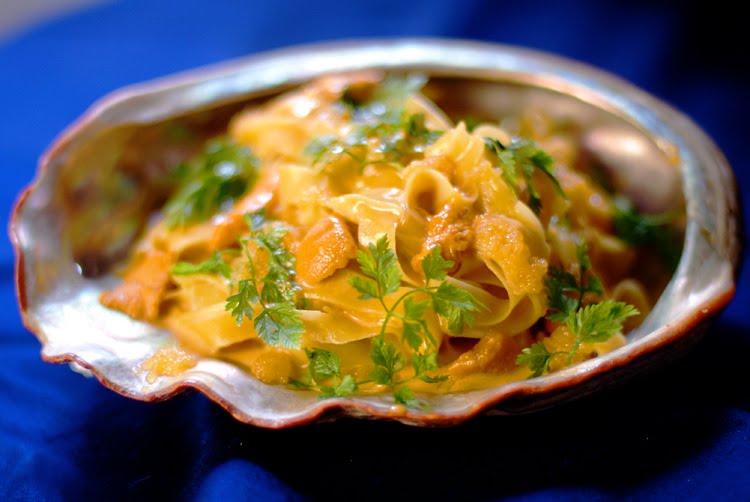
Sea Urchin with Madeira, Cream & Pasta
“They are one of the few remaining delicacies that must be harvested from the wild and cannot, for most purposes, be frozen. They are hand-cut by professional scuba divers — or, in some parts of Korea, by women who train from childhood to hold their breath and dive in cold water. These haenyo, or sea women, dive as deep as 50 feet with no gear other than a mask and a knife, gathering sea urchins, abalone, seaweed and conch. (Women are better able to tolerate cold water, and it became traditional for them to support their families by selling their catch.)"
Thursday, March 11, 2010
Apple Mousse from Ullapool, Scotland

This mousse is another one of my forever favorites. It comes from what I remember as being a Brigadoon-like town in the Scottish Highlands on the shore of Loch Broom and surrounded by the mountain An Teallach to the south. The name of the town, Ullapool (or Ulapul) is Gaelic for Wolf Farm…or Norse for Wool Farm. It is known for its art and culture and has been the location for many a film since it has changed little in 100 or so years (thanks to the railroad not going through) and for having been designed in 1788 by the noted bridge builder and architect, Thomas Telford (nicknamed the Colossus of Roads). *
Ullapool Church built by Thomas Telford in 1829
Apple mousse has been a favorite in one form or another in the British Isles for a very long time. The Elizabethans had the wonderfully named Dyschfull of Snowe that had whipped cream and egg whites, sugar and rosewater and the apple in the center of the dish stuck with evergreen. Here is the original (I know I’ve been at this too long when I read Elizabethan English smoothly!) from The Proper Booke of Cokerye, a 16th c cookbook.
To make a dyschefull of Snowe
Take a pottell of swete thycke creame
and the whytes of eyghte egges, and beate
them altogether wyth a spone, then putte
them in youre creame and a saucerfull of
Rosewater, and a dyshe full of Suger wyth all,
then take a stycke and make it cleane, and
than cutte it in the ende foure square, and
ther with beate all the afore sayde thynges
together, and ever as it ryseth take it
of and put it into a Collaunder, this done
take one apple and set it in the myddes of it,
and a thicke bushe of Rosemary, and set it
in the myddes of the platter, then cast your
Snowe uppon the Rosemarye and fyll your
platter therwith. And yf you have wafers
caste some in wyth all and thus serve them
forthe.
The Germans have something similar made with egg white named aptly apfelschaum which is apple foam in English and which is what it is like… light sweet and delicious. This recipe is not light but it is fabulous and so delicious. My memories of Scotland are fond indeed although I haven’t been back in many a year. Every time I taste this mousse I'm back again!
Midcoast Fine Antiques of Maine
When I looked at the apple mousse, my first thought was “It is beige”. I always tell my art directors that 'beige = death' on film… it’s a personal prejudice, I know. So I used my Bristol Blue Rummer for an antidote to beige and then I had this crazy idea in my head to do a riff on a Victorian tortoiseshell comb.
The hitch is that the caramel melts so don’t stick them in till you are ready to serve if you decide to try them! They are pretty easy to do simply but if you are feeling inspired you can go nuts! You can make two batches of caramel… one dark and one light and combine them on the silpat to give a real tortoiseshell look. Otherwise, let’s face it… apple mousse isn’t a stunner visually (but wait until you taste it!!). Use a cup of sugar for each color.
Apple Mousse – Based on a recipe from Royal Hotel, Ullapool, Scotland
Serves 4-6
7 c apples ( I used a combination of sweet and tart from Salt Point, NY's Terhune Orchard via Union Square Farmer's Market) peeled and cored in 1” pieces ** you can add spice to the applesauce if you wish… a pinch of cinnamon and star anise is lovely (but make sure to remove the anise before pureeing). I find with the madeira that it is best without spice. Use 2 cups of apple puree.
2 T butter
3T water
l ½ tsp. gelatin (2 T water) *** for you vegetarians, just make the applesauce a little thicker and skip the gelatin… it is still great… I have done this when I made it and realized I had run out of gelatin!!!!
1/3 C honey-mild as you can find it. (I use Champlain Valley Apiaries)
1 C cream (Milk Thistle Farms is the best cream ever!)
1 -2 T scotch or 3 T madeira (Boston Bual or NY Malmsey)
Topping
½ C pecans or walnuts
2 T butter
2 T maple syrup
Melt 2 T butter, add apples and 3T water and cook covered for 15 minutes until apples are soft. Puree.
Sprinkle gelatin over 2 T water and soften 5 minutes. Add honey and Scotch (or Madeira) to the warm apples with the gelatin and cool. Beat cream till stiff and blend into the apple mix. Add to glasses and chill.
The topping is my addition to the recipe: Sauté nuts in butter till fragrant. Add maple syrup (and another splash of liquor if you would like) and sprinkle on top of the mousse and serve. It’s nice if the mousse is cold and the nuts are warm.
I’ve made this with Scotch forever… but I tried it with the Madeira and was crazy about it. I got to use a tiny bit of The Rare Wine Company's 1922 Bual in a serving and it was amazing.
*Many of the facts are from Wikipedia or the Ullapool Tourism Bureau
Bristol Blue Rummer, 1820's
Another great Foodie Friday with Gollum!!! See her green cupcakes!