Wednesday, October 1, 2014

La Belle Créole, a Famous beauty and Her Favorite Spicy Stew, Cuban Ajiaco


Mercedes Cruz y Montalvo, Countess of Merlin (1789-1852)

Maria de las Mercedes Josepha Teresa Bárbara Luisa de Jesus Santa Cruz y Montalvo, the Countess Merlin, was born on February 6, 1789 in Havana, Cuba.

Beauty, talent, charm and good breeding combined with the dramatic vagaries of the Napoleonic war to thrust her into a life of great fame in the early 19th century only to be nearly forgotten today –– until now.

Author Alina Garcia-Lapuerta has long enjoyed reading early 19th century journalism and literature. A few years ago she became aware that Countess Merlin's name was reoccurring in much of what she read. So much so that Garcia – Lapuerta wondered that the spirit of Baron Munchausen  could have been at afoot.

In a video for her book, La Belle Créole: The Cuban Countess Who Captivated Havana, Madrid, and Paris, the author reflected, “When I started looking into her life, I found what I thought almost were too many exaggerations –– she knew too many famous people, she had been in too many interesting places at just, at certain tumultuous times and I just thought, it can’t all be true. There must be some exaggeration here. So I decided that the only thing to do was to go back from the beginning and look in the archives, look in the letters and her memoirs and in other places to really find the true Mercedes –– and once I did so I was just completely captivated by her and I had to do this project.”

Garcia-Lapuerta's passion for the subject is palpable. After I read her marvelous La Belle Créole I can admit, Mercedes reached across time and seduced me too –– her story reads like a great romance novel.

Mercedes grew up without her parents but in a loving, multi-family, multi-generational extended family. Rich and titled, her mother and father ran off to Europe to tend to business interests and advance their social standing –– leaving baby Mercedes in the care of her mother’s grandmother, Luisa Herrera y Chacón. Mercedes remembered her as having, “…snow white hair gracefully rolled up and pinned in braids exposing a perfectly formed brow and angelically sweet blue eyes. Her fine and delicate features revealed her entire soul by an ineffable expression of calm and habitual benevolence….” It was very fortunate she ended up with her mother’s side of the family. Garcia-Lapuerta noted they had “forward-looking … attitudes [that] would steep her earliest childhood days in openness, affection, and freedom that laid the foundations for her attitudes and beliefs.”

Mercedes father joined her in Cuba in her early teens in 1796. He proceeded to spoil her terribly before taking her away to Europe to join her mother.

Teresa Montalvo y O’Farrill, Countess Jeruco

Mercedes came by her charm and social skills naturally. Her mother, Teresa Montalvo y O’Farrill, Countess Jeruco was a splendid combination of Spanish aristocrat and upstart Irish (the O’Farrills). Mercedes described Teresa as beautiful and “uniting all the natural charms which heaven in its generosity can bestow upon a mere mortal.” Her father, Joaquin was a whirlwind of energy who said, “our time here was too short to lose any of it with sleep.” He evidently was never without a pot of coffee at his side. Mercedes said of him, “ Spoiled by his good star and by nature, he wished to live much in a short time and because of it he neither feared fate nor illness; he had always been happy, and nature had endowed him with a prodigious strength.” His drive paid off –– he was appointed a Gentleman of the Bedchamber to the Spanish court in 1789 and got his commission in 1794.

Teresa was known for her splendid Tertulias (social gatherings with musical and artistic overtones – like the French salon) even before Mercedes joined her. Garcia-Lapuerta wrote, “Their lavish entertainment attracted notice and comments for many decades. They had style and taste, and their musical soirées included the best instrumental and singing artists of the time….Teresa became an effective networker and flourished as a popular hostess.”

There was a good deal of rumor that Teresa was a mistress of Joseph Bonaparte, the French king of Spain. Bonaparte graciously provided Mercedes’ dowry (her father had died unexpectedly in 1807) as the family money was tied up for decades in his testamentaría (“the legal process of executing the deceased’s will”).

Mercedes was much courted in Madrid when she came of age –– the exotic Cuban beauty intrigued European men even as Spain became a prize tossed between members of the Bonaparte family in a world gone mad with war. Napoleon’s brother Joseph took control of Spain and French military men and diplomats flooded Madrid –– it was an uneasy occupation.

Christophe Antoine Merlin

The man that won her heart was a French general, Christophe Antoine Merlin. They fell in love quickly, even though he was chosen for her by her mother and was twice her age. They were married on October 31, 1809. The first years of their marriage were happy ones but not all roses and ribbons. France lost Spain along with everything else and the French had to leave the country in a hurry. Merlin had supported Napoleon so was persona non grata in France as well when the monarchy was restored. His commissions and appointments were few and far between and he only just escaped a treason sentence for his associations.

When the French occupation ended, Merlin’s money and property was forfeit in Spain. Mercedes money was and would be tied up in decades of litigation following her father’s death so the Merlins were in rather reduced circumstances when they arrived in France –– but not for long. Mercedes was a brilliant strategist. What she lacked in gold, she made up for in talent and wit. She made sure her family lived comfortably if not extravagantly. She studied voice and became a famous amateur soprano – attracting Chopin, Liszt and other great talents to her salons (she improvised Spanish songs at the piano with Chopin).
La Malibran (1808-36)

She also took to writing and earned an income with books about Cuba and even biographies like a well-received history of her friend ‘La Malibran’ –– Rossini’s diva who died too young at the height of her fame.

Even though the Merlin’s diminished circumstances wouldn’t have allowed for a grand hôtel particulaire (a private townhouse), Mercedes friends, the very wealthy Count and Countess de Lariboisière shared their mansion at 40 rue de Bondy from 1818 to 1831 with the Merlins. When the de Lariboisières moved to an even finer house at 58 rue de Bondy, the Merlins remained their guests.

It’s no wonder the Lariboisières loved having Mercedes with them. They could have a front row seat to a salon filled with the brightest talent in Paris –– writers, artists and musicians.

Alexandre Dumas was undoubtedly describing Countess Merlin when he wrote in Pauline:

“There was a tremendous crush in the ballroom; during a momentary pause, the Comtesse M took me by the arm and to escape the stifling heat, carried me to the card room; there was also a curious inspection to be made as all the artistic, literary and political celebrities of the day were there… Madame M identified them each with a charming complacency, accompanying each name with a comment such as was often envied by the wittiest society chronicler…. The ball was interrupted. Liszt sat down at the piano… The effect was magical; the sounds floated in the air like vapor.”

Mercedes was a true femme du monde. Madrid’s paper, El Heraldo captured her magic perfectly:

“To achieve fame in Paris… is the easiest thing in the world… for one hour, for two, for half a day…{to achieve it] for a week, that is phenomenal. Paris… always needs to be devouring something…. Nonetheless, as we have said, Madame the Countess Merlin is one of the few privileged beings who maintain in Paris a constant and fixed value, one of those persons who everyone knows and appreciates, even if only by name… but how, you may ask? How has a foreign lady… who has not published any masterpieces, nor possess one of those fabulous fortunes… who is not a celebrated artist… been able to conquer such a unique position.”

Garcia-Lapuerta believed that “ Mercedes united the more obvious gifts of beauty, good birth, and culture with the talents of the artist, the attractions of a witty hostess, and the elegance and stylishness of a trendsetter, along with the nurturing soul of a patroness of the arts.”

It was a glorious time to be a taste-setter when she arrived in Paris. The clothes were sublime and such a relief after centuries of imprisonment in corsets and voluminous skirts.


Sadly, the revolution did not last and hoop skirts and stays returned in all their fussy, bonneted glory.


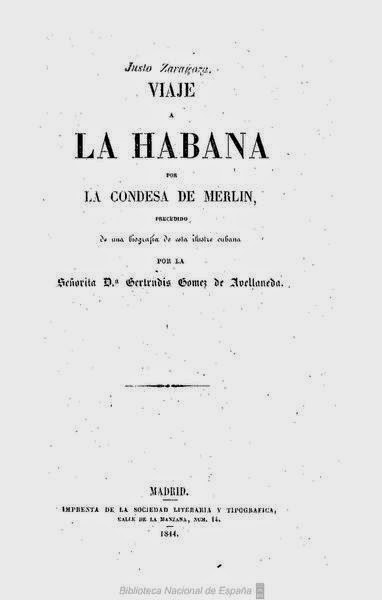
Countess Merlin didn't only inhabit the dazzling sphere of Parisian society, she made a triumphal trip back to Havana in 1840, and recorded it in a popular book that is still well respected today for its portrayal of the city in those years.


She continued to write and entertain as she entered the last years of her life but her circumstances became more humble and she moved to the country to save on the expenses of town.


 She stayed in her daughter’s husband’s 15th century castle in Dissay for a time and later in a small rented place of her own. She lived out the rest of her life with many friends who never forgot the legendary hostess.


Just as I began reading about Mercedes, my friend Mandy Aftel at Aftelier Perfumes released a new perfume that seemed to conjure my impression of Mercedes and her time magnificently. I don’t normally share perfumes here, but for some reason when I read about Mercedes I thought of her surrounded by a cloud of scent like Liszt’s music floating on the air. The way Mandy described the perfume, Palimpsest seemed to fit the bill perfectly:

"Leafing through dozens of volumes, some more than a century old, I felt as though I had stumbled into a secret old world of scent, whose story can still be read, in whispers and traces, beneath the story of the world we know.... I wanted to capture the richness that you feel when you experience the past as alive in the present, creating the gorgeous complexity of life." Palimpsest " allows you to experience the past in the present and the present in the past; in a whiff, it undoes the structure of time...."

I do not really write about perfume, so forgive my poor stab at capturing what I feel about the scent. Here’s the deal. Palimpsest is an island paradise at once bright and dark. It feels sweet at the same time it is smouldering. The ancient, unknowable deep of ambergris haunts the dark notes of the fragrance (if you follow my blog you KNOW how I love ambergris ). It is divine stuff that is NOTHING like modern department store perfume – you can close your eyes and drop through time for a moment when you wear it – to a Parisian salon during the 1830’s in a sea of Chopin waltzes, silk and ormolu.

Those of us who love food know that it transports as well, doesn’t it? We remember events more clearly when they are linked to a smell or a taste. How many of our favorite memories have the smell of a favorite dish as a powerful marker? Your grandmother may have been linked to the smell of bread, a long lost lover always comes to mind when you smell ripe strawberries – we remember home with the smell of a mother’s special stew or casserole. So it is with the elegant Countess. She may have traveled Europe and dined at the finest tables (it was the time of Carême after all) but when she returned home, fancy French food wasn’t what she wanted.

Author Alina Garcia-Lapuerta discovered this in a passage from Viaje a la Habana (Spanish version of her travel account published 1844), "On the first day [of my visit], my aunt wished to serve me one of the finest dishes from our [French] cuisine, and I, happy and satisfied with a simple ajiaco, told her in a disdainful tone: 'no, no, I do not want that; I have only come to eat creole dishes.' "

I had never heard of ajiaco, but the author was kind enough to send me a recipe, from Cocina Criolla by Nitza Villapol but modified by her ‘tia Gina’. I made a few more modifications as well but it is close to the original – proportions of meat to vegetable can be altered to taste. It smells rich and satisfying as it bubbles away on the stove. The root vegetable thickening is brilliant and adds creamy texture without calories. There are many layers of flavor and texture to it. It is not the Creole food I am used to at all –– it’s not spicy in the least. It is mild and earthy and perfect for a cool fall day.


Traditional Cuban Ajiaco, Serves 6

Meats:
½ chicken – cut up into pieces (approximately 1 ½ lbs.)
½ lb. flank steak, cubed
1 lbs. pork pieces or spareribs (I used boneless pork chops)

OPTIONAL: ¼ lb. beef jerky (tasajo) (Tasajo is a traditional ingredient, but many cooks today – including my aunt – leave it out. If you choose to use it, it must be cut into pieces and soaked overnight and cooked with the chicken as directed below).

Vegetables:

2 ears of corn, cut into 4 fourths
½ lb. yellow taro root (Malanga) peeled and cut into chunks (I couldn’t get this so used more yucca and sweet potato)
½ lb. cassava (yuca – can be fresh or frozen) peeled and cut into chunks
½ lb. sweet potato (boñiato) peeled and cut into chunks
½ lb. fresh pumpkin (calabaza) peeled and cut into chunks
1 green plantains (unripe) peeled and cut into chunks
1 ripened plantains (starting to turn black) peeled and cut into chunks
sliced beans (optional)
1- lime for recipe plus more for squeezing on top
Salt – to taste


Sofrito:

1 tablespoons olive oil
½ onion chopped
2 garlic cloves minced
½ cup tomato puree
*1 small green pepper chopped
Salt – to taste
Black pepper – to taste
½ tsp. cumin
1 tsp. dry oregano or a T or 2 of fresh

* I steamed a poblano and pureed it with 3 T olive oil and drizzled it on the portions instead of including it in the sofrito.

Directions:

In a deep stock pot, place about 3 ½ quarts of water and the chicken pieces (this is the time to add the beef jerky – previously soaked overnight – if you choose to use it). Bring to a boil and simmer for approximately 30 minutes or until the chicken is almost cooked (the beef jerky will take longer to soften). Add the other meats and simmer for another hour or until all the meats are tender.

While the meats are cooking, make the sofrito and prepare the vegetables except the ripened plantain and the pumpkin. Soak the green plantain pieces in lime juice.

To make the sofrito, heat the oil in a sauté pan and add the onion, garlic and pepper. Sauté until beginning to soften, then add seasoning. Cook a minute more and then add the tomato puree. Cook for an additional 5 minutes.

When the meats are tender, begin adding the vegetables (except ripened plantain and the pumpkin). Add the lime juice used to soak the green plantains. Add the sofrito. Cook for approximately 1 hour at lower heat or until all vegetables are tender. Add the ripened plantains and pumpkin and cook until these are tender (approximately 30 minutes).

Adjust seasoning to taste. Add the beans and cook for a few minutes till cooked through

If you wish to thicken the broth, remove some of the vegetable pieces, puree them and add that back to the stew –– I used about 1/4 of the vegetables.

Serve with lots of lime -- it is fabulous with a good healthy squeeze of lime juice and all that squash, spoon the green pepper puree over the top and sprinkle with fresh oregano.


Follow Me on Pinterest

Wednesday, September 17, 2014

Hawaii's Loco Moco –– A Radical New Style of Burger!


I have been living in the 1960’s of late –– immersed in murder and mayhem while working on a television program this summer. It’s taken me away from Lostpastremembered for quite a long stretch without much in the way of food in the scripts to inspire a post and diabolical catering that dulled my appetite down to a nub. Still, there was a Hawaiian Luau scene in one of the stories that captured my attention. Hawaiian Luau? Hmmm. Now that I’ve got a bit of time to breathe, it’s time to play in the kitchen again.


When I went to research the American variety of the Luau in the 60’s for the movie, I discovered that Hawaii was hot in 1964. Hawaii was a new state as of 1959, Hawaiian music, dance and fashion had been popular since the 1940’s. Those Hawaiian shirts were terribly popular in the 50’s –– think of all the Hawaiian prints in 1953’s From Here to Eternity. In 1961, Elvis Presley’s Blue Hawaii ignited the flame once again not to mention the surfing craze.


Donna Reed and Montgomery Clift in From Here to Eternity (1953)

Hawaiian Luaus were the rage –– grass skirted tables, Tiki torches and PuPu platters decorated back yards and Tiki bars everywhere. 


Out of curiosity I thought I would look into real Hawaiian food –– all I knew was the Americanized version with flaming drinks, paper umbrellas in Mai Tais (not to mention such icons as Hula hoops, leis and grass skirts and surf boards that made delightful deposits in the American culture bank).


Don Draper went Hawaiian

It seems that Hawaiian food is a lot like American food. It is gift built from many waves of of visitors and their cultures. Originally, Polynesian travelers arrived and brought food and animals to the unpopulated island in 300CE. Taro, coconuts, yams, sugarcane and meat and fish cooked in ovens come with them. Americans and Europeans came in the 18th century and contributed salted fish and pork. Chinese, Korean, Japanese, Philippine and Portuguese foods came with laborers and sailing ships. As a result, Hawaiian food is a grand mix of many cuisines. 


One of the most popular and enduring imports is American Spam. A gift of WWII American occupation, today it is used in everything from stir-fries to a kind of sushi available everywhere called Spam musubi. Spam teriyaki is a great hit and it can be in Saimin noodles included in a  Hawaiian classic with the catchy name of Loco Moco  –– it can even replace the hamburger in the dish.

Loco Moco is a wonder of many cultures –– macaroni salad and hamburgers with a beefy gravy and fried eggs married to a sort of fried noodle that is a blend of Chinese and Portuguese cuisines and the multi-national rice (the dish shares a rice and macaroni salad combination of the Hawaiian “plate lunch” that includes an entrée – originally a leftover special that became a classic).

Loco Moco was created at the Lincoln Grill restaurant in Hilo, Hawaii at the request of teenagers who called the dish “crazy” after a friend’s nickname Loco once they tasted the wild alternative to a simple burger. Moco was added because it made it sound like fun. It is certainly a carbohydrate overload that’s fun, filling and full of flavor. It will make your guests laugh to hear the name and smile to enjoy the flavor combinations.


Loco Moco, serves 4 (adapted from Guy Fieri recipe)

3 c cooked brown or white rice (rinsed before cooking)
4 hamburgers (or slices of Spam if that't your preference)
Loco Moco gravy

4 Fried eggs (sunny side up, cooked in butter)
Hawaiian Macaroni salad
Fried Saimin noodles

Put rice on a plate, top with a bit of Loco Moco gravy, hamburger, gravy on the burger and the fried egg on top.

Put Hawaiian Macaroni and fried Saimin noodles on plate with burger and serve.


Hamburger

1 lb hamburger meat
¼ c chopped sweet onion
oil for the pan
salt and pepper to taste.

Gently combine the meat and onion and seasoning and make into 4 paddies. Cook in a hot covered skillet for 2-4 minutes a side for R to M. Set aside.  * substitute Spam slices if you would like


 Loco Moco Gravy

1 T unsalted butter
¼ c diced sweet onion
1/3 c chopped mushrooms
1 ½ c low sodium beef broth (I reduced Whole Foods rather watery beef stock to make it richer)
2 T demi glace (optional)
2 t Worcestershire
1 T cornstarch

Sauté onions and mushrooms in butter in the pan in which the burgers were cooked, scooping up and browned bits. Add the stock and reduce a bit. Add the demi glace. Add some water to the cornstarch to make a slurry and add to the gravy to thicken.

Hawaiian Macaroni Salad based on a Wanderlust Kitchen recipe (serves 4)

1 c dry macaroni, cooked
3 T cider vinegar
1t brown sugar
¼ t salt
½ t pepper
½ c mayo
½ c milk
2-5 packets wasabi (to taste – I love the heat so went full out)
1 green onion, sliced
1 carrot, grated
1 stalk celery, thinly sliced

Cook macaroni as instructed. Drain, and toss with cider vinegar, sugar, salt and pepper and allow it to cool for 10 minutes.

Add 1/2 the milk and mayonnaise and blend. Chill

Add the chopped vegetables and the rest of the mayo-milk.

Fried Saimin Noodles (based on Hawaii cooks with Spam cookbook recipe)

½ pound fresh saimin noodles or fresh pasta, cooked
1 T oil
¼ c chopped onion
1 c chopped cabbage
1 carrot, grated
1 c sliced, cooked string beans
1 green onion, sliced
¼ c chopped Spam (optional)
1” piece ginger, grated
1 t hoisin sauce
2 T soy sauce
1 T oyster sauce
1 T sesame oil
additional green onion slices for garnish


Cook the noodles and set aside. Sauté the vegetables and Spam if you are using it in the oil until softened. Add the noodles to the pan and heat. Add the ginger, hoisin, oyster and sesame oil. Sprinkle with extra green onion slices for color


Follow Me on Pinterest


Monday, July 28, 2014

Hardwick Hall, Bess and 16th Century Spinach Fritters


Elizabeth Hardwick, painted 1550 (born 1520 to 27, died 1608)

Elizabeth Hardwick was born in the early 16th century –– a contemporary of Elizabeth 1st and definitely cut from the same fierce cloth. Although her beginnings were modest,  4 brilliant marriages increased her stature exponentially. She became enormously wealthy, powerful and respected –– with a brilliant mind and indomitable will –– she even defied Queen Elizabeth and got away with it. She was quite a dame.

I have felt drawn to her for many years, probably because she loved architecture and impressed her love of light upon the builders and architects of her houses to such a degree that it inspired a rhyme about Hardwick house, “Hardwick Hall - more glass than wall.”  The lady certainly had the wherewithal to see her original designs realized. I've always wanted to see the hall in person.

I finally got to cross Hardwick Hall off my bucket list.


I had known about Hardwick Hall for eons but was surprised to discover Old Hardwick in noble ruins beside the new hall. I was in love.


Bess's very individual ideas about houses can even be seen in the ruins of Old Hardwick.  She decided to place the reception rooms (the most grand spaces in the hall) on the top floor instead of following the traditional plan that put the reception rooms on the ground floor –– 'tis better to see England's emerald vistas from a lofty perch.


The lush countryside was easy to view through the large windows. In a way, Hardwick Old Hall was a dry run for the new hall, but only just.  Bess had been born in a small medieval house on the property, but she tore it down and started over in 1587, just a few years before employing Robert Smythson to build her “Prodigy House” in 1590  right next to it (a prodigy house was a grand place meant to impress visiting kings and queens on their progresses (both an honor and a curse, the trips could empty the coffers of gentry who had gotten a bit to big for their britches –– long stays were ruinously expensive). Smythson was an excellent choice for New Hardwick.  He was a master mason on Longleat (you can read about it HERE) who had been bumped up to the category of “surveyor” or “architecter” by the time he built divine Wollaton House –– he was much in fashion by the time he worked at Hardwick.

 Old and New Hardwick Hall were both fully engaged to entertain large parties during Bess's time.

16th c Spanish leather (Shoe & Leather Museum) from Surface Pattern Design 

New Hardwick is grander but the remaining lineaments of the old hall (and remarkably detailed household inventories of Bess’s time) show a house of great elegance and charm filled with tapestries and an uncommon amount of tooled leather hangings. Many of the of the old house's fine contents were deployed to various family properties when the old house was no longer habitated.  It did have a second life as a ruin.  Trees were actually planted inside the house amidst crumbling floors.  It was a fashion in the 18th and 19th century to have a ruin (known as a folly) on your property –– neither ancient crumbling abbey, Norman castle or faux classical Temple as was the fashion, Hardwick Old Hall was an unusual folly as is stood next to a house that was the same vintage as the ruin.


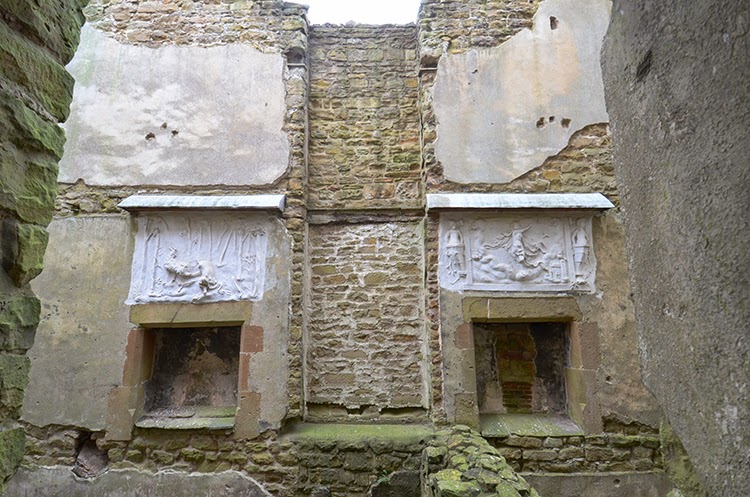
Now missing most floors and open to the skies, small lead 'roofs' offer some protection for the plasterwork that has been limed to show up white as could be.


There is even the ghost of the great kitchen with giant fireplaces and ovens. How I wish I could have seen it in its prime.


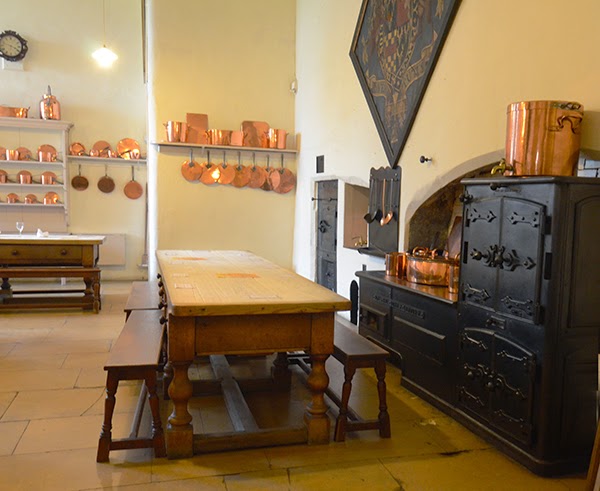
You can definitely see what it might have been when you look at the great kitchen of the new hall

The furniture is 19th century


Modern cast iron stoves replaced the great fireplaces in the 19th century –– although some of the earlier ovens and cooking surfaces remain on the right, and a turnspit hangs over the oven as a reminder.

Glowing copper replaced the old Tudor era pots and pans.


The above stairs was pretty posh too.


Of course there’s the famous view with the amazing windows and Bess’s initials carved rather proudly like alphabet crowns. When she entertained on the roof (as was the fashion of the day), it must have had quite an effect on the guests.


There were brilliant receiving rooms like the High Great Chamber with the captivating huntress Diana holding court in the forest frieze that circles the room.

Detail of Frieze (Country Life Magazine)


The great long gallery is the largest surviving Elizabethan example of the form –– 51 meters (167’) long and still decorated with mostly original hangings.


A 19th century addition of a fun but wildly overdone late 17th century State Bed tester adds a bit of drama.


The Sea Dog table -- thought to be one of the most important Elizabethan pieces to survive to the present – pictures do not do it justice – takes your breath away.

Then there are the beds, here are just a few of them ––

The cut velvet dressing room

The blue room

My favorite was the green velvet room

Dining Room 

Admittedly, the dining room was a bit of a letdown. It is fine in its own way, but the 18th century furnishings lack the strength of the furniture from Bess’s time when great massive tables would have been set in the more grandly proportioned rooms. This just felt mismatched and wrong. Bess came before the idea of a separate dining room had become fashionable.

I had to think more “Great Hall” than the motley Hardwick dining room as I pondered my favorite question, what did they eat?

Bess, 1580

As the New Hall was built between 1590 and 1592, I thought something from Bess’s time would be appropriate. Since she lived to a vibrant 80 or more (her birth date was not certain – anything from 1520-27), I thought she must have enjoyed good healthy food to keep up with the demands of running so many households (Hardwick, Chatsworth, Sheffield Manor, Tutbury Castle and Wingfield Manor).

The Good Housewife’s Jewel was written in 1596 by Thomas Dawson and it’s full of great recipes for vegetables, stews and pies as well as desserts (although they were part of the dinner and not thought to be a final course at that time). It seemed a great resource for Bess's nosh.

It was hard to choose between an almond broth stew, oyster pie and spinach fritters but spinach won the day.  I imagine Bess, pouring over plans whilst popping a few of these dainties for sustenance -- washed down with a good English ale.

To make Fritters of Spinnedge.

Take a good deale of Spinnedge, and washe it cleane, then boyle it in faire water, and when it is boyled, then take it forth and let the water runne from it, then chopit with the backe of a knife, and then put in some egges and grated Bread, and season it with suger, sinamon, ginger, and pepper, dates minced fine, and currans, and rowle them like a ball, and dippe them in Batter made of Ale and flower

I was fortunate that I did not have to develop a recipe this time -- wrangling measurements out of the barest hints of proportions in the 1596 description of the dish can be trying and time consuming.  Lucky for me, the brilliant Mark Melton, food historian at Hampton Court (that I wrote about HERE) had already done the legwork and Christine Muelke of the NYTs had published it in 2006.

They are addictive, delicious and surprising.  The spinach sort of dissolves into a greenness and they taste a bit like a donut with a warm, spicy filling.


Spinach and Date Fritters (Adapted from Hampton Court Palace.)

8 ounces spinach
3 large eggs, beaten until smooth
½ teaspoon salt
¼ teaspoon freshly ground black pepper (I added a bit more pepper)
½ teaspoon ground ginger
¼ teaspoon ground cinnamon
4 ounces (about 20 medium) pitted dates
2 ounces (scant ½ cup) currants
½ cup fine dry bread crumbs, or more as needed
Vegetable oil, for frying
1 cup all-purpose flour
1 cup beer
Confectioners' sugar, for dusting.

1. Bring a large pot of water to a boil and add the spinach. Cook until thoroughly wilted, then drain well in a colander and cool. (I was very naughty and didn't cook it at all –– I squeezed the water out
after chopping).

2. Squeeze out as much water as possible and transfer spinach to a cutting board. Using the back of a large knife, pound the spinach repeatedly to break down the fibers in the stalks and leaves. When the spinach has a mashed appearance, chop coarsely. Transfer to a large bowl. Add the eggs and mix well. Stir in the salt, pepper, ginger and cinnamon.

3. Using a food processor, or by hand, finely chop the dates and currants. Add to the spinach mixture and stir until blended. Mix in ð cup bread crumbs and allow to sit for 2 to 3 minutes. The mixture should be thick enough to shape into balls about 1 ¼ inches in diameter. If necessary, add more bread crumbs to obtain the right consistency.

Make 24 balls.

4. Place a wide, deep pan over medium heat and add enough oil to come about 1 ½ inches up the side of the pan. Meanwhile, in a small bowl, make a batter by mixing together the flour and beer, stirring until very smooth.

5. When the oil is shimmering, dip a spinach ball in the batter, allowing any excess to drip off. Place the ball in the oil. It should begin to fry immediately, turning light golden brown in 1 to 2 minutes. Remove and drain on paper towels. Repeat with the remaining balls and batter, adjusting heat as necessary. Dust with confectioners' sugar and serve hot.

Makes 24 fritters.

I'm off doing 2 episodes of a TV series (1960's crimes-fun!).  Will try to be do a blog every few weeks and not be gone so long!


Follow Me on Pinterest