Thursday, December 8, 2011

Goose –– Wicked, Delicious – Smoked in Garbure (a French Stew) & Roasted with a Holiday Drink


I really don’t like geese. 

My beloved German grandmother’s family had a picture-book farm in Wisconsin. The gigantic dining table was a wonder –– placed in front of a huge fireplace –– I think it sat 20!  The kitchen smelled like the best bakery in the world since there was always something cooking there.  My great aunt Amelia, who towered over her tiny, but well-turned-out husband Fred (who still had his old-fashioned lace-up shoes custom made for him 60 years after they had gone out of fashion) was the matriarch of the family and a formidable woman. Legend has it when Fred died, she picked up the phone and called the funeral home, “Fred’s dead, pick him up” and went back to her work. For some reason I remember her hair so clearly, pulled astoundingly tightly, forming a tiny braided bun on top of her head.  I realized why she always went on about my gram’s, thick, still auburn hair (at 75) when I saw the bun down one day –– it was down past her waist but thin as a pencil –– it was hair envy!  She was a tyrant around the farm, and everyone quivered at the sight of her.  Her kitchen was so clean you could perform surgery there without hesitation –– everything gleamed from continual polishing and scrubbing.

The house was really extraordinary and I marveled at its 3-foot thick stone walls like some medieval castle.  Every doorframe had 2 doors, every window had 2 inner and outer windows.  It was always the perfect temperature, winter or summer because of this massive construction.  The house was built to last until the end of time.  Its boon and its curse was that it stood right by Lake Michigan, a fact that made it very valuable (the lake formed one edge of the property).  Her dim children, who didn’t feel any love for the place, when approached by developers sold it for a pile.  I never had the heart to find out if the magical house was torn down.  My small consolation (schadenfreude?) was that it would have been a hellish job.

It was at this farm that I learned about farm animals, drank milk warm from the cow (it was like drinking warm cream and insanely rich), and eating home-smoked sausages and hams and eggs fresh from the chickens.  I didn’t know how lucky I was. 

It was on one of these visits that I had my first encounter with anser anser domesticus and it wasn’t pretty.  I was young, 7 or 8, and having a grand time running about the land.


My great uncle Bill had an octagonal barn down the road at his place and my brother and I just had the time of our lives swinging from a rope and dropping into the hay below.  We were Tarzan and Errol Flynn all rolled into one that day… and we got away with it without getting caught, score!

We were back at Amelias’ when the attack happened.    I had visited the lovely cows and laughed at the very charming pigs (having a hard time imagining them as bacon and already having a bit of an issue with killing them for food… especially after meeting them!).   We opened a gate to walk to another barn.  Out of nowhere the squawking started.  A gaggle of geese came around the corner… honking like mad and led by an enormous gander.  We made eye contact and I knew then and there my goose was cooked.   I ran and he ran after me.  My brother made it over the fence clean but I wasn’t so lucky.  The white demon bit my leg brutally hard as I was climbing the fence.  It was a completely unnecessary and vicious thing to do.


When I made it over and looked back he was still honking and looking at me with the most malevolent stare imaginable.  Think Jurassic Park's Velociraptor  … that’s the look (the real velociraptor was only the size of a goose,  and we now know it had even had feathers –– the movie folks went for the larger Deinonychus for a size model and changed the face to make it look more sinister –– they changed the name because, well, Velociraptor sounds sexier than Deinonychus). I swear, he must have been an ancestor of my feathered nemesis –– but I digress...


I discovered that guarding is in the nature of geese.  Wikipedia said that the sacred flock of geese in the temple of Juno Moneta on the Capitoline Hill saved Rome from the marauding Gauls in 300 BCE by alerting them of a stealthy night attack. The epithet Moneta could have come from the Latin word monere –to warn or from the word mon for mountain or hill.  As of 273 BCE, the mint was established in her temple and the word money may have come from that association.  Perhaps that is where golden egg laying geese came from?? As it is, whole books have been written about geese in folklore.

I know, carrying a grudge for a lifetime is really bad –– but, well, I have and it has only recently abated–– somewhat.   My early Bambi dietary laws (don’t eat anything cute) put goose at the top of my meat list for years.  I asked for a Christmas goose for years.


Fast forward to adulthood.  I made my first Christmas goose in my new apartment.  After all, goose was the first thing Elizabeth the 1st ate to celebrate the sinking of the Spanish Armada –– she recommended it to her people to celebrate Christmas as a fitting tribute for the accomplishment and the blessing of saving the kingdom. It was delicious and there was a great degree of satisfaction cooking it.  I stopped making it since my ex didn’t care for goose–– many don't after bad experiences with tough, greasy, badly prepared birds.


I hadn’t made goose in many years when a friend delivered a beautiful specimen to my door from an upstate farm last month.  I marinated it in Madeira and was rewarded with a gorgeous bird by reworking a Cook’s Illustrated recipe I found (for the life of me I couldn’t find my old recipe!). 

I thought I’d get the most out of it by making stock with it but the last time I tried it years ago, it was a disaster and tasted just plain nasty.  My friend, Ken, told me my mistake had been cooking it too hot. My next effort was spectacular.  Goose was now back in my virtual pantry.

This brings me to Jim Schiltz. 

I discovered Schiltz Goose Farms in South Dakota (thanks to my friends at D’Artagnan) while researching foie gras and gavage (the method of force feeding to enlarge a bird’s liver) a few months ago (Schiltz doesn't force feed, by the way).

I realized that when I was young I thought all foie gras was from a goose (foie gras d’oie).  Now it is almost always duck (foie gras de canard) … so much so that it no longer labeled as such.  Foie gras is now almost exclusively duck.

But what of the goose?  As I discovered in researching foie gras, the goose was the first bird to be fattened for their livers –– the Egyptians began cultivating foie gras thousands of years ago and began domesticating them even further back.

I asked my friends at D’Artagnan about goose recommendations and they sent me to Schiltz Goose Farms. 

Photograph from Schiltz Goose Farm

Starting with a few Toulouse eggs in 1944, they have become the largest producer of goose products in the US.  What I found on the site was truly amazing. They began by raising weeder geese!  Did you know that geese were the often raised as weeders?  They were released in fields to keep the weeds down  in fields of cotton, strawberries, asparagus and mint.  They were replaced by herbicides in the 1960s, which I now understand was a good thing since the poor bird's weed diet was not good for them.

By that time the Schiltzes had begun raising geese for meat.  They are free-range birds who live their lives mostly outdoors, living on feed and foraging which makes for the most flavorful and nutritious birds.  Jim Schiltz said, "For the whole smoked goose we use geese that have been processed within our USDA (P-242), SQF Certified facility, that came from our farm in South Dakota, where they are raised in an extreme free range setting.  The geese begin their lives indoors for a couple weeks, then are given the choice of being inside or outside.  They have approx 100 sq ft per bird to run around in, in other words 400 to 500 geese per acre.  Once they eat the grasses that are planted for them down, we bring them fresh greens daily.  It is a world apart from the factory farming that rightfully upsets people." 

Although I got the goose liver that had drawn me to Schiltz to begin with ( that I will share with you soon)  I also got a smoked goose from Schiltz after I saw they were available.  When I got the package I was knocked over.  It is the meatiest, juiciest goose I’ve ever seen (it was nominated for the 2012 Taste Awards)!  It was so big that it went to the front of the recipe line because my freezer (already toooo full) couldn't contain it and, well, I couldn't wait to taste it!  It was so good that stripping the bones of the meat, I tasted like mad and each bit was fantastic with different tastes and textures from every part of the bird, WOW (and they are offering great deals on shipping for the holidays!)

But what to do???  I had an idea to use it in a cassoulet or something like. 


So, where to go for the recipes?  Geese, country life, farm-fresh ingredients ­­­­–– my mind started wandering to Baron Roy Andries de Groot.  Ok, you may ask, what does a blind gourmet who lived in Greenwich Village have to do with farms or geese?  Well, he wrote a wonderful book about a tiny hotel run by a pair of French food muses, Vivette Artaud and Ray Girard.  The book was called The Auberge of the Flowering Hearth.  de Groot felt their cooking expressed the unity of their way of life –– a beautiful expression, don't you think?  It was the first book of his that I read… I mean, how could you not with a title like that… it practically oozes poetry, doesn’t it?  de Groot found the inn by chance on a trip to research the famous Chartreuse liqueur and endeared himself to the women who ran it.  He stayed with them for months, coming and going with the seasons and writing down local recipes that had never been written down before.  It was the cuisine of the place and the seasons and de Groot loved the idea of both.  He was an enormous proponent of food in place and of the season and the recipes in the book capture that place perfectly.

It was a cold and rainy day as I went on my goose chase. I took a detour and got lost in the Alpine valley of La Grande Chartreuse near the village of Saint-Pierre-de-Chartreuse and L’Auberge de l’Atre Fleuri.  What these divine ladies do with eggs and cheese is worth the price of the book, and the stories –– well de Groot makes you feel like you are there –– he’s a splendid writer.  I was having too much fun revisiting the book, no matter that there were no goose recipes for me there.


Returning to the task at hand after my virtual visit to Auberge, I reached for another volume of his called Feasts for All Seasons, I just knew he would have what I wanted.  This book actually preceded Auberge by a few years but the same principals are in evidence (don’t worry, I’ll revisit Auberge again and tell you more about de Groot –– he was quite a character). It was written in the 60’s and the recipes have that feeling about them –– caught as they were between the style of classic French cuisine and the soon to be hot international savor our food was to transition to –– with a little 60's supermarket mentality thrown in (although de Groot lived in Manhattan and had unusual ingredients at his fingertips he was writing for the general public and had to make concessions in authenticity for the less adventurous). 

In the chapter, “The Family Meals of the Fall” I found a perfect recipe for my goose, he calls it La Garbure.  It was nestled between New Orleans Jambalaya and Moorish Lamb Couscous.  


He says it is a famous peasant dish from the Pyrenees and includes the direction that it should be thick enough that the ladle stands up in the stew –– cooked and served in a toupin (this would have been stuck in the back of the fireplace to cook low and slow - Le Fanion in NYC has them). I have made some changes like using a smoked goose  (but I warmed it in fat so it became like smoked confit).  

It wasn’t a cassoulet in the classic sense since de Groot made it with green beans and not dry beans and it is soupier in a way, but when I did a little research I found the original French version used fresh white beans or dry… so I threw in some cooked dry beans and added cabbage that was as ubiquitous as root vegetables in the many recipes I found.  I think de Groot wouldn’t have minded the changes since he recommends using what you have to make it (he chose the peculiar addition of green peppers which I decided to skip—this was the 60’s after all). When making garbure (and many other things) I agree with my friend Ken Albala … use the recipe as a guide.  You need not adhere to the ingredients like they were written on stone… use what you want.  I do recommend those chestnuts.  They give it a soft, warm je ne se quoi.

This has always been a soup of the country… of Gascony and the Basque region… the name Garbure probably came from the Spanish garbias meaning stew.  The most famous version is from Béarn (yes, as in Bearnais, although the sauce didn’t come from there!) in the Pyrenees Mountains and was served in 2 courses with the soup coming first –– spooned over the bread slices, and the meat as the main course with served with cornichons and salad and sometimes with pickled hot pepper. 

I could imagine it working in great Aunt Amelia’s kitchen superbly… and it’s a great way to avenge my white-feathered nemesis’ attack so long ago… lots of cooked goose!!!


La Garbure (serves an army… 10 easily)

2 legs and 1- ½ breast, 1-½ thigh from a smoked goose from Schiltz Goose Farms (save the rest for later… or use it all if you would like… this baby has a lot of meat
4 cups goose or duck fat  OR use 6 pieces of homemade duck or goose confit.

2 slices bacon or a bit of pork belly or Ventreche (it needn’t be smoked because the goose is)

salt (won’t be necessary if you are using smoked goose which is salted) and pepper

1 dry chili pepper
3 cloves of garlic
2 m carrots

A solid chunk of roast meat OR remains of pork butt OR ham hock OR Toulouse sausage* OR Keilbasa OR smoked pork chops  –– OR a mixture of any or all of them, whatever you have around or are in the mood for… I read that this soup would sit at the back of the fire for weeks or months in its toupin and that things would be continually tossed into it so that it was constantly evolving… a nice idea.

1 lb green beans, tipped and trimmed (or fresh limas or the traditional fresh, shelled white beans) and/or
1 cup white beans, soaked and cooked till softened (I would do more, perhaps double at least 1 ½)
1 lb baked and shelled chestnuts (I used a jar of cooked French chestnuts)
2 large Leeks or 4 small (white part) in 1” lengths (use one for the stock and one for the soup)
1 lb small boiling potatoes
1 small Savoy cabbage, shredded
2 m white turnips, peeled and cubed (about 2 pounds)
1 bottle Beaujolais
2 T chopped marjoram and thyme
1 bunch parsley, chopped

Slices of toasted bread… with garlic herb butter, even better.

If serving in 2 courses, serve the meat with cornichons and salad with a light vinaigrette.


Cut the goose into breast pieces, legs and thighs and remove the meat from the bone. Reserve the bones… break them into smaller pieces. Reserve the skin for cracklings –– they are sooo good!   Melt the fat in a deep skillet.  You can add any fat from the goose to the pot and render it as you go, then remove what remains.  Add 1 breast and the legs and thigh and cook over a very low heat for 1 hour (reserve the rest, or use it all if you would like –– this goose had a lot of meat).  Skip this step if you are using your own confit.

Remove from the fat when cooled somewhat –– leave fat clinging to the meat. If you want a rich broth… use the fat that will pool on the goose meat… otherwise leave it on the plate when you put the meat in the soup. Adding it will make it very rich (you can save it and add it later if you are worried about the fat).

Sauté the bacon in a large pot (around 10qt) until it is brown and has rendered a good coating of fat.  Sauté the leeks and garlic.

Add 2 c of the red wine and bring to a boil for a few minutes.  Add enough water to come halfway up the pot and bring to a boil (I used the whole carcass so used about 3 QT that gave me 2 Qt of stock).

Add the bones and the ham hock and hot pepper and simmer for 3 to 5 hours until you have a good stock (I usually do it till the meat falls off the bones to get what I like and that took 5 hours). Remove the ham hock and the goose bones. Discard the bones and remove the meat from the ham hock and reserve.

Skim the fat (I did this the day before and let it cool and then removed the fat and brought the stock up to a simmer).

Add the turnips, bring to a boil and reduce to a simmer and cook for 20 minutes.

Add the potatoes, halved, the leek split and careful washed and cut into 1-inch pieces.  Add the scraped carrots, cut into chunks. Bring this to a boil and then reduce to a bare simmer for 30 minutes. Then add the salt (with the smoked goose you don't need it) and pepper.

Fry the sausages if they are raw. Prick them and brown them to loose some of the fat.  Leave the meat in big chunks if you are using it and add it and/or the sausages to the pot. 

Put the green beans and chestnuts and cabbage into the pot and add the confit and meat you have harvested from the ham hock and cooked dry beans and cook another 30 minutes at a bare simmer.  Sprinkle with fresh herbs.

Remove the large pieces of meat and sausage.  You can either serve these separately on a platter as it is traditionally done, and place mostly vegetables in your individual soup bowls and ladle the broth over them or slice into bite-size pieces and return them to the tureen and ladle them out together.  Either way, put 2 T of red wine into each bowl before ladling the soup and serve with toasts.


Toulouse Sausage

1 pound ground pork
1/8 lb pork belly, finely chopped (a processor works well for this)
1/8 c white wine
1 T Madeira ( Boston Bual from the Rare Wine Co.)
1 t salt
1 t sugar
½ t pepper
small clove garlic, minced
¼ t nutmeg
pinch of sage and thyme
1 2’ length of sausage casing

Combine all the ingredients and let sit in the fridge for an hour.  If you don’t have a sausage stuffer, use a pastry bag and fill the casings with the mixture but it takes a strong hand.  Tie the sausages off at 6 or 8” lengths and put in the fridge, uncovered to dry for a few hours.


 Roast Goose

1 goose(you can order one from Schiltz Goose Farm)
1-2 T madeira (Boston Bual from Rare Wine Co. is perfect

3 T hazelnut oil, frozen
1 T heather honey
2 T chopped fresh herbs

s&p

1 cup red wine
3 T Madeira
½ c demi-glace

Put the goose in boiling water for one minute and remove, Turn it upside down and do it again.  Remove, pat dry and rub with madeira put in the fridge on a rack, uncovered overight.

Heat the oven to 325º 

Remove, salt and pepper the bird.  Stuff the frozen hazelnut oil, honey and herbs under the skin of the breast. Place the bird on the rack, breast side down.  Roast it for 1 1/2 hour. Remove from the oven and remove the accumulated fat.  Turn it so the breast side is up and cook another 45 min to hour.  Check it to see if it is done…if the drumstick meat feels soft when you push on it,  you are ready.  If it is, turn the oven up to 400º and remove the bird.

Transfer the bird with the rack to a jellyroll pan and let roast for 15 more minutes to crisp the skin.  Remove the liquid/fat from the roasting pan while this is cooking. Separate the fat from the juices.  Deglaze the pan with the red wine and Madeira.  Pour back the lovely juices you have separated from the fat and add the demi-glace.  Adjust the seasoning and serve with the sliced goose (which should have been resting 10 minutes while you do this).  If you would like a thicker sauce, add a few T of flour to the sauce… make a slurry with some red wine and add to the sauce, stir till thickened.


My friend David Solmonson over at 12 Bottle Bar asked me to come up with something that fits the bill for a holiday drink.  I pulled a few books out (real and virtual) and settled on one that David of 12 Bottle Bar had sent my way, the  Café Royal Cocktail Book from 1937.   I was feeling color and went for drinks with red in it. 

When I found the Pink Rose I asked Petunia, my St. Bernard, her opinion (she was hovering since it was past her walk-in-the-park time) and she said “woof”  (which is an expression we use in the film business when we move things to camera… when it’s where you want it, whoever’s looking through the lens says ‘woof’).  I knew I was on the right track.  The picture above is an homage to her good taste. 

Something about pink froth seems right for the holidays.

You see, I love pomegranates and pomegranate juice.  When I found out grenadine was made from them, well I was shocked… it tastes nothing like it.  I found a recipe to make it and decided I was going to give it a go one day… that day has come.

As you see, the recipe couldn’t be easier and it’s so wonderful to look at.  I did change it a little since the grenadine was so delicious…. I had to have a little more of it!


Petunia’s Pink Rose (2 small or 1 large drink)

1 egg white
2 T grenadine (recipe follows, its the best you ever tasted!)
2 T cream
2 t lemon juice
2 T to 4 T gin to your taste

I don’t have a cocktail shaker so I whipped the egg white with a mixer till a loose meringue formed.  Then,  I put the rest in a jar and shook it like mad.  I combined them gently and voilá,  Petunia’s Pink Rose.  I also made a star out of the grenadine in the center.

Enjoy it for the holidays!!


Grenadine (this makes about 1 ½ cups)

1 c pomegranate juice (about 3 pomegranates should do it or buy the juice)
1 c unbleached sugar
1 oz pomegranate molasses
1 or 2 drops Aftelier Petitgrain or 1 t orange blossom water

Heat the juice just enough to melt the sugar… keep it low so you don’t lose the fresh flavor. DO NOT BOIL! Add the molasses and dissolve and then add the petitgrain or orange flower and you are good to go.  Some people advise adding vodka to give it staying power… it is fresh juice after-all.  I say… use it all up for a party… you’ll be glad you did!!!


For the best chef gifts, go visit Aftelier, she has the best essences on the planet and I use them ALL the time from Bergamot to rose to jasmine and fir... they make magic!  This is an unsolicited recommendation... just love to share great things (and she's having a holiday sale!).

Thanks to Gollum for hosting foodie friday!


Thursday, December 1, 2011

Armagnac, Paris and Duck Wellington with Armagnac Sauce


I discovered Armagnac in Paris a very very many years ago.  I was young and my boyfriend and I walked all over the city for a few perfect weeks.  This was a great way to see the city but now that I seem to have lost my travel diary, a bad way to remember places… especially since I have no sense of direction at all (I could get lost in a paper bag with a map).  After all these years the names may have faded with my idea of where things were exactly but the most important part of the memory never does. I remember my first taste of Armagnac and magret de canard from that trip as if it were yesterday.

On one of those walks we entered an enchanted cave of a place because I was taken with the look of the owner as I peered through the window.  He looked like a large version of John Drew (John Barrymore’s uncle) with a handlebar moustache that belonged to another age.  His energy level was so expansive you could feel it through the glass.  He seemed to take a shine to me and even made me believe my fractured French was charming—he was the perfect host.

One of the first things I noticed about the place was a large cabinet filled with hand-labeled bottles of Armagnac. The handwritten labels made them seem very special… slightly blackmarket and exciting.   He was opening the latticed door to the cabinet frequently and pouring from the bottles for his patrons.   The mutual affection was palpable.


 When it was time to order, he took charge and I was so glad he did.  After rich soup and a surprising salad of bitter greens and confit, he introduced me to rare duck breast.  I was in heaven and would have willingly stayed there forever if I could have done. The experience led me to try to attempt smuggle some raw duck breast in my suitcase (stuffed in tall boots) on the plane back so I could make it in NYC. It did not work.  I was busted in customs and lost my duck breast and my pride (they were not amused) to the customs agents.  

I was still swooning from the duck and a dark Gascon wine (also with a handwritten label) when I asked him about his Armagnac.  He was over the moon to show his collection off to a young American obviously in his thrall.  He began pouring… young Armagnac, old Armagnac –– he loved this stuff and although I was never much for spirits –– his enthusiasm was infectious.  He even came up with an Armagnac soufflé.  Although I could barely walk when I left, I still remember his gigantic smile and enormous personality.  I can’t think of Armagnac or magret de canard to this day without thinking of him.


Armagnac comes from the Pays de Gascogne.  Unlike cognac, it is only distilled once and actually pre-dates cognac by at least 200 years having first been mentioned in 1411 as aygue ardente,, aygue de bito or eau de vie made by a man named Antoine (not that Antoine was the first, Arnaud de Villeneuve was distilling wine in 1250 and the Chinese were using the technique 3000BC). The reason for this, said Brandy Classics was the association between the Islamic learning center in Salerno and the University of Montpellier.  It was from this association that the Arab art of distillation was learned (I wrote about distillation and polymath Persian chemist Avicinna HERE).  A 1441 record said that the “distilled spirit relieves pain, keeps one young and brings joy.”  It came to be known as Armagnac during the 16th century and was popular with Dutch sailors (it was the Dutch who taught the vintners of Cognac the technique centuries later).

Once I starting poking around I couldn’t stop and found a wonderful, informative article by Charles Neal.

Unlike cognac, which is 72% alcohol, Armagnac is only 53-60% alcohol and distilled in a continuous still called an alambic (from the Greek ambix that means a pot with a small opening to the Arab’s al ambic for the distilling equipment). In Armagnac they still use portable versions (most made from the classic copper material) that are shared by many vineyards… driven from farm to farm during the season.  The lower alcohol content and single distillation method helps the spirit retain more “esters, acids and congeners” which give it more rustic flavor… that and many years in oak casks, known as une piece armagnacaise, using either Gascon oak from the Moniezun forest which is rare and gives the spirit more tannin or Limosin which gives it more vanilla.  It is these techniques that give Armagnac its distinctive flavor.  Although the best armagnacs are not adulterated, lower priced Armagnacs can be adulterated with boisé (a boiled wood chip product) sugar syrup and caramel for color.  The real thing spends a long time in oak and doesn’t change once it is bottled.  Some Armagnacs have spent as much as 30 years in cask (anything more leaves them dry and too woody).  They also are vintaged which cognac once was but is no longer.

Armagnac is made from 4 grapes, Folle Blanche, Ugni Blanc, Colombard and Bacco 22A.  Before the Phylloxera epidemic, Folle Blanche was the primary grape used but it is a delicate grape… hard to grow and prone to disease.  These days Ugni Blanc is the largest component of Armagnac.  Bacco is the dark note of the mix.  From what I read, Neal doesn’t care for the colombard component. 

There are also 3 regions of Armagnac: Bas-Armagnac, Ténaréze (this is where my bottle hails from), and Haut-Armagnac.  Any Armagnac that is only labeled Armagnac comes from any or all of the regions and is a blend.  Those labeled with the district have distinct personalities of the place… the terroir if you will, that has very different soils and so, different and distinct flavors.

A good bottle of Armagnac is not cheap. An old bottle will set you back a few hundred dollars.  The amazing site, Finest and Rarest  has an amazing selection for those of you who are interested in shooting over the moon of flavor (of many wines and spirits, not just Armagnac… it is a site to dream on).  I can say from experience that the old Armagnacs are truly wonderful and full of a rustic glory ––wild and untamed yet elegant.  I always like to recommend using good quality for cooking.  Then, if you want to finish it with a tiny bit of the great stuff at the end… that will give you the most bang for your buck.

The recipe that I will share with you is one that I’ve been wanting to make for sometime.  duck breast Wellington.  Last time I made beef Wellington (that I wrote about HERE), I said to my guests that I thought duck breast would be great done that way.  A strange combination of circumstances led me to make it for Thanksgiving when my plans to go away were canceled the day before.  I had duck breast in the freezer and thawed it (thanks to D'Artagnan, I don't have to smuggle it in my boots anymore...).  I made my duck fat puff pastry and used a small piece of cooked foie gras I had left over from the movie as part of a mushroom duxelle (using mushrooms left in the fridge). This was totally a last-minute dinner that turned out spectacularly and the Armagnac sauce  (another thing that I’ve wanted to make for sometime) was perfect.  I know –– having demi-glace and truffle butter handy is a little unusual (let me tell you when the hurricane threatened my electricity being cut off, I saw my frozen treasures threatened and shook in my boots at the possibility of losing it all… I was much blessed not to have had that happen) but I was glad of it when this could come from it (Dr. Lostpast thinks I am a freezer hoarder). 

My fix for a blown holiday made skipping overcooked supermarket turkey and nasty side dishes became a great idea–– may do it next year!


Duck Wellington for 2

s&p
¼ t 5-spice powder
1 T Armagnac
½ t Dijon mustard
1 T apricot pureé or jelly

4-5 m. mushrooms (wild or white), chopped
1 T truffle butter
1 t thyme leaves (fresh)
1 T Madeira
1 T  cognac
3 T foie gras , fresh or mousse ( I love their cubes –– I keep them in the freezer and chop them off as needed)

1 piece of puff pastry*(approximately 9x12)
1 egg beaten with 1 T milk

1 clove garlic, chopped
1 small shallot, chopped
2 t butter
3 T  Armagnac
s&p to taste
1 T basil jelly**, gooseberry or current jelly, optional
2 T truffle butter
2 t truffle oil

Rub the duck in salt, pepper and 5-spice powder.

Take the fat of the duck breast and sauté to release the fat and remove. Saute the duck breast on both sides in the fat till browned then remove and cool.  When cool, stir together the armagnac, mustard and apricot and brush on the duck and rest.

Saute the shallot and garlic in the butter.  Add the chopped mushrooms and sauté. Add the thyme leaves. Add the liquors and reduce.  If using fresh foie gras sauté gently.

Lay out the puff pastry on a sheet of parchment and place the cooled duck breast on one half.  Cover with the mushroom/foie gras mixture.  If using mousse, spread a layer on the duck before adding the mushroom mixture.

Close one half of the pastry over the other and close by wetting one side and pressing them together firmly, I used a combination of a folk and a pastry wheel to clean up the edges.  It is necessary to put slices into the paste so that it will spread as it rises.

Return to the fridge for 15 minutes. Preheat oven to 425º and place the sheet pan you will be using in it to heat it. Brush the egg and milk mixture all over the pastry and then place on the pre-heated pan.

Bake for approximately 30 minutes.  Be watchful, each oven is different.  Also, turn the sheet midway to assure even baking.  Also, if you use additional decoration as I did, remember to check it… it will brown faster since it rises higher than the rest and should be covered with a foil strip before it burns.

While the pastry is baking, make the sauce. 

Saute the shallot and garlic in the butter.  When soft, add the demiglace and reduce slightly.  Add the armagnac, salt and pepper to taste.  Add the jelly if you wish at this point.  Allow to cool  slightly,  and add the butter to make an emulsion. Add the truffle oil.

Remove the duck and let it rest for a few moments before slicing.  Serve with the sauce.

*Recipe for basil jelly HERE   … I love the stuff


*Duck Fat Puff Pastry

Butter layer

1 lb + 3 ½ T (510g) cold unsalted butter
2 t (10 ml) Lemon juice
1 c (130g) bread flour
pinch of salt

Dough

3 c (400 g) bread flour (freeze it)
3 ½ T (55g) duck fat, frozen)
2 t Salt
1 c cold water (start with 3/4 and add as needed, you may not need a whole cup)

Mix the butter and the flour and lemon and salt into a paste, make a 6” square and chill on wax paper till firm

Knead very sparingly and refrigerate.

Make the dough into a rectangle and put the butter in the center in a diamond... fold the dough around it like an old envelope, bringing the 4 outer points to the center of the butter.   If it’s warmed up, chill it. Otherwise roll it to a rectangle and fold it like a brochure and chill ½ an hour. Roll it out and do it again 6 times, resting for ½ an hour to an hour in the fridge each time (if you have a cold kitchen, less time is needed).

I left mine overnight after the 5th turn and made the last turn the next day. I rested it one more hour and rolled it out.  You will have enough for 3-4.  Freeze what you do not use.


 For great midcentury objects and furniture for the holidays, visit my friend Diana's online store!

Wednesday, November 23, 2011

Food in Film, Duck with Port and Cherries, Duck Ragout with Pasta and Cream Sauce (and other camera-ready delights!)


I discovered that movie food was different from real food pretty early in life.

I was in love with old movies, especially swashbucklers.  I loved watching them and reading about them.  The beautiful tables groaning with plate and goblets and gorgeous food made me want to eat like my favorite characters. My poor mother got some peculiar requests for her shopping forays to be sure.  I assumed that what we saw was real and delicious. 


Pouring over old movie star bios as was my wont in those days (I was under 12 after all), I was shocked to discover that Tyrone Power was nearly killed by a chicken.  Yes, a chicken. 

You see, there are 2 different types of food for film, the edible type and food for show.  It seems Power took some of the latter and that had been sprayed with DDT to keep the flies away.  He decided suddenly to eat the chicken… not a scripted move at all, and before a horrified prop could stop him, he had taken a few bites and was taken quite ill.

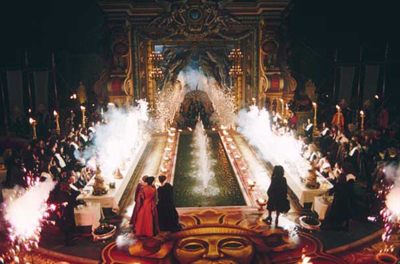
Adventures of Robin Hood (1939)


It comes out that much of the food on film set tables… food that has to sit for hours under hot lights or in the sun, is faux food or altered to give it staying power.  What is eaten is switched out between takes to keep it fresh and edible.


When I grew up and went into the movie business as a member of the art department (the department responsible for food) I learned all of this first hand.


I loved hearing set stories from films shot in NY and, as a serious foodie, was especially bowled over by the amazing work that was done by chef Rick Ellis (who also did the food for American Psycho--- quite a stretch!) to recreate late 19th century New York society dinners.  The scenes were further enhanced by a remarkable collection of china and decoration amassed by decorators Robert Franco and Amy Marshall (under the watchful eye of designer Dante Ferretti) on Scorcese’s The Age of Innocence.  It blew me away (believe me when I tell you what they did was heroic).

There are so many others like the great Babette’s Feast (which I’ve written about HERE) that I've actually cooked dishes from and is a particular favorite.

Vatel


Another food-centric favorite was Vatel (a story of the baroque chef who committed suicide when the fish delivery was late) that featured extraordinary food scenes and decoration.

Marie Antoinette

That baroque style was featured once again in Sophie Coppola’s magical Marie Antoinette.

But movie food tells a story.  Sometimes the austerity of the table speaks volumes about what is going on in the film.  It’s not all about pomp and grandeur.  It's about telling a story about lives lived.  What and how we eat says a lot about who we are to quote Brillat-Savarin,  "Tell me what you eat and I'll tell you who you are."

Who can forget the genius of Orson Welles in Citizen Kane as the whole life of a marriage is shown in the changes at the dinner table, from this:


to this:


or how the relationships in Ordinary People


or American Beauty


can be enriched by the architecture of the dining room,  the design of the food, the decoration and even the lighting.


Seduction can come with only perfect lighting and a bunch of grapes... and of course Garbo.

As many of you know, I have taken a break from working in films to write this blog.  I did a return engagement for a director I love for a film he wrote and directed. It seemed only right that a major component of the film was a dinner.   I forgot what 14-hour days felt like!  I cooked and cooked and in the end it was a huge success.


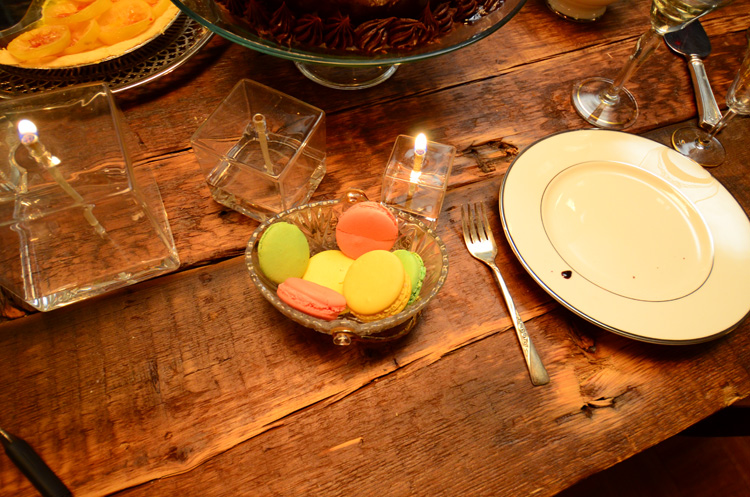
All of the food was edible.  We had no DDT sprayed chicken! The days of shooting at a dinner table were made easier with oil lights from Firelight Glass –– not having to worry about candle continuity was a real pleasure.  The table came from Made of New York  and was magnificent.  I wanted a table with a lot of character to offset the shine of the dishes.  The table is made from wood from old NYC buildings and is a hundred years old or more.


The meal was written with duck –– a lot of duck in the described dishes –– so I called D’Artagnan – the best place on the planet for great duck!

First, a few weeks before shooting, I went through photos online to show the director so he could pick what he liked visually based on what he had written. We do this for all elements of the film with the director from furniture to paint colors to what’s on a table.  We call it show and tell.  For that, my input is added to what I have read in the script.  For instance, although the script said ‘duck ravioli’, I found a picture of an open ravioli (and a description of the dish from Walter’s Bistro reported by Kevingeats. ) to show him an open-faced ravioli because I told him you wouldn’t see there was duck ragout in a closed up one.  From dozens of photos he chose the ones he wanted.

I did have to make some changes to the recipes.  The food had to last through a whole day of lights and eating since we didn’t have the budget for multiples (actually, in a larger film, I wouldn’t be doing the cooking… outside my job description). 


The crayfish were on a base of canned cream of celery (the real thing would have separated in an hour) and was based on a picture from choosy beggars that the director had loved.  The canned soup stayed exactly the same all day long (it was never intended to be eaten, only seen).  The parsley oil did dissipate over the course of many hours and a crayfish being removed to a plate for 4 takes.


The foie gras was sautéed and placed on a swirl of apricot jam that stayed beautifully, sadly I didn’t remember to snap the picture till the end of the night!!

One picture taken in natural light, fresh on a plate… what a difference!

For the duck with cherries, I used plain old cherry pie filling cut with a little pomegranate juice.  I brushed the duck on the platter with oil to keep it moist and we added to the actor’s plates with fresh duck.  They did eat it all day and I was gratified that the kids on the set, who I was told were picky eaters, said they now loved rare duck breast… to the amazement of their mothers.  For the real recipe I would make my old standby, cherries and port… so good!

This is after 10 hours of shooting!

For the duck ragout pasta, I did make the ragout with duck confit and it was delicious.  I bought fresh pasta, boiled it and cut it into squares.  I laid down a bit of spinach with my handy giant tweezers and then some duck and Boursin cheese and covered it with more pasta and a drizzle of sauce (I made this from a description that went with the picture I showed the director… and it was delicious).  I then slathered it with bottled Alfredo sauce…  a necessity because homemade cream sauce would have separated in a minute.  Again, the store-bought stuff stood up beautifully and looked the same from beginning to end.  The only near disaster came when I left my cooking area and someone used a tea kettle, moving the platter of pasta I had placed there.  When they were done, they put the platter back but left the burner on super low instead of off!!!!  I caught it before it broke but had to so some repair as the middle had really heated up and the ragout was leaking out of the pasta in an unpleasant way.


For dessert I enlisted the aid of Erika Beth at Life’s Too Short to Skip Dessert  to make them, since I am not the queen of desserts.  Even while running the NYC marathon and prepping for an opera (she is an accomplished opera singer too), she stepped up to the plate and came through with chocolate cake and a lemon tart and cupcakes.  We had to make a few changes to make them more like the pictures the director approved (swirls on the cake and caramel on the lemons) –– something that often happens on shoots.  It was it great that she made them… the crew ate them up afterward!  I made madeleines for an extra plate on the table (4 days later they were stale as could be, but fresh they were perfect).


I read about the new  Dominic Ansel Bakery  on Spring Street in NYC and had to get some of his famous macaroons… they were wonderful and so colorful!


I used Daniel Boulud’s recipe for Madeleines courtesy of  Donuts to Delirium since I couldn't find the Elizabeth David recipe I usually used and they were just as good as she had promised!!


THE RECIPES


Duck Breast with Cherries and Port Sauce

2 duck breasts from D' Artagnan
salt & Pepper
Preheat the oven to 400 degrees F.
With a sharp knife score the fat of the duck breasts in a criss-cross pattern. Season the duck with salt and pepper. Warm a cast iron skillet over medium heat.
Place the duck breasts, fat side down, in the skillet to render the fat, about 6 minutes. Turn the duck breasts over and sear for 1 minute. Turn the fat side down again and place the skillet into the oven to roast for 7 minutes, until breasts are medium rare. Rest them for 5 minutes then slice.  (this technique is from  the food network),

Cherry Sauce with Port

2 shallots
1 T butter
1 c sour cherries (fresh or frozen are best)

½ c port
2 T basil jelly or current jelly
1 T cognac
S&P to taste
Pinch of 5 spice powder
Pinch of ginger
Pinch of cayenne

Saute the shallots in butter then add the cherries, wines and jelly and spices.  Reduce the sauce and pour over the duck.

Duck Ragout Ravioli with Boursin Cheese

Duck Ragout

2 T butter
1 m onion, chopped
2 m carrots, chopped
1 stalk celery, chopped
4 duck confit legs from D'Artagnan, skin and bone removed and chopped coursely (or meat
from a whole duck cooked low and slow or even chicken thighs cooked low and slow)
1 glass red wine
1 cup chicken stock
1 T armagnac
3 T tomato paste
2 T mixed fresh herbs (parsley, thyme, sage, rosemary)
salt and pepper to taste


Saute the vegetables in the butter till soft.  Add the confit and the rest of the ingredients and cook for 45 minutes over a low heat.  What should be left will be thick and rich.

Boursin Cream Sauce

½ t minced garlic
2 T minced onion
2 t butter
2 c heavy cream
1 package Boursin Cheese
¼ to ½ t nutmeg
1 T madeira (Boston Bual from Rare Wine Co)
1 t cognac
2 T chopped parsley
s& p to taste

Saute vegetables in butter, when soft, add the cream, reduce somewhat then add the cheese and the rest of the spices and parsley.

1 bunch spinach, sautéed with salt and pepper, squeezed dry  and chopped
3 sheets  fresh pasta, boiled and sliced into squares.

Take enough of the pasta to cover the platter and place on a warmed up, heat proof platter slathered with a layer of sauce.  Top each square with some of the spinach and a T of the ragout.  Top with another square.  Spread the rest of the sauce over it and place in a 300º oven to warm for a few minutes… then serve.

Lemon Tart based on an Epicurious recipe 


Tart Shell:

  • 1/3 cup almonds (about 2 ounces)

  • 1 1/4 cups all purpose flour

  • 3 tablespoons sugar

  • 1/4 teaspoon salt

  • 6 tablespoons (3/4 stick) chilled unsalted butter, cut into 1/2-inch pieces

  • 2 tablespoons (or more) ice water


  • Candied lemons:
    2 large lemons, sliced very thin on a mandoline
    3 c. sugar
    3 c. water (plus more for blanching)

    Lemon Filling:

  • 2/3 cup fresh lemon juice

  • 1/2 cup sugar

  • 3 tablespoons crème fraîche or sour cream

  • 4 large eggs


  • Caramel
    1 C sugar
    ¼ c water

    Tart Shell: 

    Finely grind almonds in processor. Add flour, sugar and salt and process until blended. Add butter and process until mixture resembles coarse meal. With machine running, add ice water, 1 tablespoonful at a time, and blend until moist clumps form, adding more water if dry. Gather dough into ball; flatten into disk. Wrap in plastic; chill at least 1 hour and up to 1 day.

    Preheat oven to 375°F. Roll out dough on floured surface to 12-inch round. Transfer to 9-inch-diameter tart pan with removable bottom. Fold dough overhang in, pressing to adhere and forming double-thick sides. Pierce dough all over with fork. Freeze 20 minutes. Bake crust until set and light golden, piercing with fork if crust bubbles, about 30 minutes. Cool crust on rack 15 minutes. Maintain oven temperature.

    Candied lemons:

    Bring a large pot of water to a boil. You want to use a large pot so that your lemon slices aren’t crowded in the pot to ensure that the pieces stay in tact. Carefully add lemon slices, and blanch for approximately 3 minutes. Drain lemon slices, and repeat the process one more time.
    Bring 3 c. sugar and 3 c. water to a boil, and add blanched lemon slices. Simmer for 25 minutes, and remove to cool/dry on a cooling rack, piece of wax paper, or a silpat.


    Lemon Filling

    Whisk lemon juice and sugar in medium bowl to blend. Whisk in crème fraîche. Whisk in eggs 1 at a time until well blended. Pour mixture into crust.
    Bake tart until filling is set, covering crust edges with foil if browning too quickly, about 35 minutes. Cool tart completely in pan on rack. Refrigerate until cold, about 2 hours. (Can be prepared 1 day ahead. Keep refrigerated.)

    Remove pan sides, Top with candied lemons.


    Take the sugar and water and slowly cook to golden caramel.


    Spoon the caramel over the lemon slices and serve.


    Thanks to Gollum for hosting Foodie Friday!