
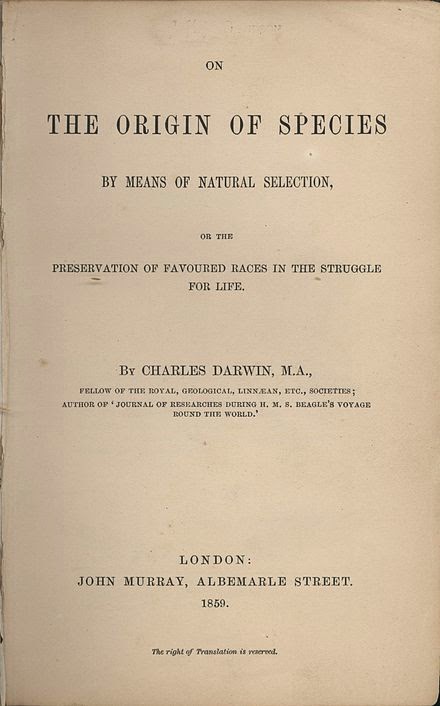
“Evolution in nature is not inconsistent with the notion of creation, because evolution requires the creation of beings that evolve.” Pope Francis
Including the whole of the human race in the “beings that evolve” group would be somewhat optimistic –– some of us seem to be going retrograde in a Dark Ages, World-is-Flat kind of way. You’d think more than 150 years after Charles Darwin published On the Origin of the Species evolution wouldn’t be news, would you? Yet the theory of evolution is fomenting controversy in 2014 nearly as dramatically as it was in 1859.
Evolution is happening all around us (you can watch a superb video about it HERE.
EVOLUTION:
The process by which different kinds of living organisms are thought to have developed and diversified from earlier forms during the history of the earth.
OR
The gradual development of something, especially from a simple to a more complex form.

Charles Darwin (1809-1882)
I can’t help but see evolution at work as I read about Charles Darwin’s own family history and explore the zeitgeist of the time. So many elements in Darwin’s background pointed him toward writing his magnum opus ––would it have happened had he not sprung from and been nurtured by his family’s storied intellectual roots? Would he have written On the Origin of the Species if his grandfather hadn’t begun working on the topic so brilliantly 70 years before?
That’s one of the best things about working on this blog. I started reading Emma Darwin’s cookbook, and ended up learning about the remarkable Darwins!

Erasmus Darwin (1731–1802), 1770 by Joseph Wright
It’s a history that begins with Darwin’s grandfather, Erasmus Darwin –– a genius in his own right and a founding member of the Lunar Society –– a full orchestra of geniuses whose ideas and inventions would lead to the birth of the Industrial Age in Britain (there’s a book about them The Lunar Men: Five Friends Whose Curiosity Changed the World if you want to know more).

Soho House in Birmingham, one of the meeting places for the Lunar Society (1765-1813).
First, to explain the name, Lunar Society –– it’s not all DaVinci Code dark or metaphysical in the least –– it was practical. It seems that the group met on the full moon of every month because the moon lit the dark streets and made it easier to return home after gatherings that lasted into the night. The members proudly called themselves “Lunartics”

Wedgwood Jasperware Pegasus Vase, 1790
Aside from Darwin, other members included Matthew Bolton (who worked with Watt on the steam engine), James Watt (who invented the steam engine), Josiah Wedgwood (potter and close friend of Erasmus Darwin –– it was Wedgwood’s son who convinced Charles Darwin’s father to let him go on the voyage of the Beagle –– Josiah was also the grandfather of Emma Darwin), Benjamin Franklin, Joseph Wright (painter), William Small ( Physician and Thomas Jefferson’s professor) and assorted other important philosophers, scientists, abolitionists, chemists, engineers, inventors, lawyers, printers and poets from Europe and the United States. Although many members could not attend the meetings in person, there was a lively correspondence between them that went on for decades –– new members were recommended by established Lunartics.
The Lunar Society began with Erasmus Darwin.

Erasmus Darwin House Museum, Lichfield and another Lunar Society meeting place
Darwin was born in Nottinghamshire and went to university in St John’s College, Cambridge, then studied medicine at the University of Edinburgh Medical School –– the best there was at the time.
In 1757 he moved to Lichfield, Staffordshire and became a successful physician.
“What an amazing polymath and Enlightenment thinker Dr. Erasmus Darwin was. He made major contributions to learning in 75 diverse areas that included:
"1) abolition of slavery 2) ventilation 3) mental illness 4) microscopy 5) warm and cold fronts 6) afforestation 7) water closets 8) moon's origin 9) treatment of dropsy 10) animal camouflage 11) nerve impulses 12) wind-gauges 13) artesian wells 14) windmills 15) artificial insemination 16) nitrogen cycle 17) manures 18) women's emancipation 19) biological adaptation 20) biological pest control 21) origin of life 22) canal locks 23) outer atmosphere 24) carriage design including steam carriages 25) phosphorous 26) photosynthesis 27) centrifugation 28) cloud formation 29) compressed air 30) rotary pumps 31) copying machines 32) secular morality 33) educational reform 34) sewage farms 35) sexual reproduction 36) evolutionary theory 37) speaking machines 38) exercise for children 39) squinting 40) fertilizers 41) limestone deposits 42) formation of coal 43) steam turbines 44) geological stratification 45) hereditary disease 46) insecticides 47) telescopes 48) language 49) temperance 50) timber production.”

Erasmus Darwin, 1794
“From thus meditating on the great similarity of the structure of the warm-blooded animals, and at the same time of the great changes they undergo both before and after their nativity; and by considering in how minute a portion of time many of the changes of animals above described have been produced; would it be too bold to imagine that, in the great length of time since the earth began to exist, perhaps millions of ages before the commencement of the history of mankind would it be too bold to imagine that all warm-blooded animals have arisen from one living filament, which THE GREAT FIRST CAUSE endued with animality, with the power of acquiring new parts, attended with new propensities, directed by irritations, sensations, volitions and associations, and thus possessing the faculty of continuing to improve by its own inherent activity, and of delivering down these improvements by generation to its posterity, world without end!”
In this excerpt you can see that Charles Darwin’s path was basically predestined. It's as if it was in his DNA to continue and then improve upon his grandfather’s ideas (some of Erasmus’ ideas had been proved wrong even though they were tantalizingly close – some of his ideas were decades, if not centuries ahead of their time). It was fortuitous that Charles had no interest in becoming a physician –– his father had insisted on medical school but Charles wasn’t keen on the subject and did poorly. He changed course and schools and followed his interest in botany and biology. That choice changed everything. Once his passion was inflamed, his unquenchable thirst for knowledge led him to develop his theories on survival of the fittest. He shared a lot with his polymorph grandfather. You could say evolution was bred in the bone.

Charles Darwin’s recipe for rice in his own hand, written into his wife’s cookbook
What he didn’t share was the family appetite (I did start this research because of food after all—the charming idea of peering into the kitchen of a famous scientist was too much to resist –– yes, Charles Darwin went into the kitchen and even wrote recipes!). The whole reason we are here is a recipe from Emma Darwin’s recipe book that I wanted to make.

Down House, Darwin family home from 1842 – 1906
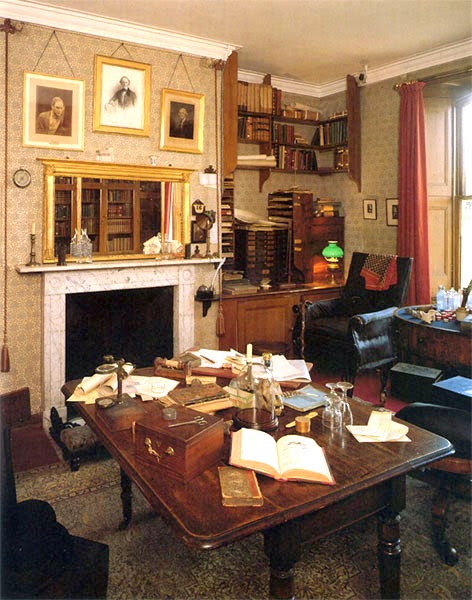
Darwin’s study at Down House(English Heritage photo)

Darwin Dining Room (English Heritage photo)

Darwin Dining Room(English Heritage photo)

Mrs. Darwin’s Wedgwood China, Water lily pattern (designed 1806)

Emma Darwin and children
Darwin had a large family and a warm and loving home that his wife Emma took great care to feed well. Although Charles may not have always appreciated her efforts –– there was a reason. Thing is, Charles Darwin had a very troubled stomach – they are still trying to figure out what was troubling him (Crohns disease is a contender).
.jpg)
Erasmus Darwin by Joseph Wright, c1792.
Charles’ grandfather, Dr. Erasmus Darwin, as you can see, was a rather large man (as he got older, he got fatter –– his dining table had to be cut out to accommodate his girth).

Robert Darwin (1766-1848), Charles Darwin’s father
Erasmus’ son, 6’2” Robert (Charles’ father), was a giant of a man who would grow to over 336 pounds and still live to be over 80!

Charles Darwin, 1840
Darwin was just under 6’ but normal weight (although after his return from the voyage of the Beagle, he weighed but 149 pounds!).
Erasmus’ grandson Charles did not have the appetite of his forebears because of his condition that he described in a ghastly terms:
“For 25 years extreme spasmodic daily & nightly flatulence: occasional vomiting, on two occasions prolonged during months. Vomiting preceded by shivering, hysterical crying, dying sensations or half-faint. & copious very palid urine. Now vomiting & every paroxys[m] of flatulence preceded by singing of ears, rocking, treading on air & vision. focus & black dots – All fatigues, specially reading, brings on these Head symptoms ?? nervousness when E[mma] leaves me ..."

Emma Wedgwood Darwin 1808-1898
It seems his wife was his rock, his nurse and his loving companion. She catered to his every complaint without complaining. They had a long and loving relationship with 10 children –– he adored her. Remarkable considering the famous ‘note’ that Darwin wrote before proposing to her:
“This is the question
Marry
Children — (if it Please God) — Constant companion, (& friend in old age) who will feel interested in one, — object to be beloved & played with. — —better than a dog anyhow. — Home, & someone to take care of house — Charms of music & female chit-chat. — These things good for one's health. — Forced to visit & receive relations but terrible loss of time. —
W My God, it is intolerable to think of spending ones whole life, like a neuter bee, working, working, & nothing after all. — No, no won't do. — Imagine living all one's day solitarily in smoky dirty London House. — Only picture to yourself a nice soft wife on a sofa with good fire, & books & music perhaps — Compare this vision with the dingy reality of Grt. Marlbro' St.
Marry — Marry — Marry Q.E.D.
Not Marry
No children, (no second life), no one to care for one in old age.— What is the use of working 'in' without sympathy from near & dear friends—who are near & dear friends to the old, except relatives
Freedom to go where one liked — choice of Society & little of it. — Conversation of clever men at clubs — Not forced to visit relatives, & to bend in every trifle. — to have the expense & anxiety of children — perhaps quarelling — Loss of time. — cannot read in the Evenings — fatness & idleness — Anxiety & responsibility — less money for books &c — if many children forced to gain one's bread. — (But then it is very bad for ones health to work too much)
Perhaps my wife wont like London; then the sentence is banishment & degradation into indolent, idle fool…”
July 1838

Charles and Emma were first cousins
Emma Darwin was a brilliant woman in her own right. Now that the Darwin papers are online, you can actually read her diaries and letters –– they are warm and intelligent.

Josiah Wedgwood (1730-1795)
Her side of the family wasn’t too shabby either. Her grandfather, Josiah Wedgwood, was a brilliant and creative man who was constantly innovating both his pottery and the methods for creating them –– he was a 4th generation potter but an injury prevented him from doing the work himself. He was also a passionate abolitionist. Wedgwood pottery continued to thrive for over 200 years (it recently joined with Waterford in what proved to be a poor alliance meant to keep it afloat –– people don’t buy such things anymore -- a pension scandal nearly lost the Wedgwood Museum's treasures).


There’s also a book out there Mrs. Charles Darwin's Recipe Book: Revived and Illustrated Ill Edition by Dusha Bateson, Weslie Janeway, written by two fine scholars using original material and interpreting the recipes for today’s cooks. My recipe was not in the book so I had to do a bit of sleuthing to put together the different parts so you can cook it.
I decided to go to Queen Victoria’s chef Francatelli’s cookbook, The Modern Cook and a popular 19th century cookbook, The Cooks and Housewife’s Manual by Margaret Dod (that I wrote about HERE) for guidance. From these I came up with some recipes for forcemeat and white fricassee of chicken.
You only need a whir or 2 of a food processor to make the sausage for 'padding' the pie and the chicken comes together quickly. There was plenty of sausage left over and it's delicious as a breakfast patty or with pasta. The piecrust can be prepared beforehand and then deployed and the puff pastry purchased. If you don’t have the puff pastry handy, use regular pie crust dough. You can make one large or 4 small – just make sure you have enough dough since it takes a bit more for 4 dishes. I used a smaller pie pan and then used the rest of the crust in a pate dish since my puff pastry remnant was a bit small for a full size pie plate. I have to say I used my recipe puff pastry that I had made 9 months ago and it rose like mad with a zillion layers -- takes time to make but so worth it.
Here are the original recipes. You can make changes as you see fit. I for one decided the suet to meat ratio a bit high for my sausage (and remembered the oil spill of my pizza experiment) so I cut it down considerably –– Emma's dish makes no mention of additional fat but I only had ham slices and they were fat free so the mixture did need a bit of moistening. The extra sauce is delicious on the side.
From The Modern Cook:


From The Cook and Housewife's Manual:


Mrs Darwins Chicken Pie (Mont Coquins Chicken Pie)
1 piece piecrust dough
1 recipe forcemeat
1 recipe fricassee
1 piece puff pastry (bought or from recipe HERE) or another piece of piecrust dough
Preheat oven to 400º.
Place the piecrust dough in the serving dish. Press the forcemeat against the sides of the
plate. Put into the oven and cook till
sausage is done and crust browned, about 20 minutes. While that is cooking, put the puff pastry
cut in the shape of your dish on a piece of parchment paper and pop in the oven
for about 10 minutes with a piece of parchment over the top. Remove parchment, bake for
10 more minutes then brush gently with egg wash and cook 5 more minutes until golden.
10 more minutes then brush gently with egg wash and cook 5 more minutes until golden.
Sop up any excess oil. Put the fricassee in the pastry with some of the sauce and sprinkle with fresh
herbs. Top with the puff pastry and serve extra sauce separately

Fricassee of Chickens
2 chicken breasts and 2 chicken thighs with bones and skin
OR
2 boneless chicken breasts.
1 T butter
1 carrot, sliced
½ an onion sliced
1 stalk celery
½ c mushrooms or mushroom trimmings
3 cloves
12 peppercorns
½ t mace
3 sprigs of parsley
1 quart broth
2 T butter
3 T flour
4 egg yolks
1 T butter
3 T cream
½ cup sliced mushrooms, sautéed in butter (optional)
salt and pepper to taste
1 -2 T madeira to taste (I used Rare Wine Co. Porto Moniz Verdelho Special Reserve-fabulous)
fresh herbs for garnish
Sauté the chicken in butter till lightly browned. Add the vegetables spices and herbs to the pot with the chicken broth and simmer for about ½ an hour for the whole chicken. Only cook the chicken breast for 15 minutes. Remove and keep cooking the vegetables for another 15.
Strain and reserve the chicken. Melt the butter and flour in a pan and cook, slowly, for 3 minutes – do not allow to brown. Slowly, add the broth stirring all the while. Cook for ½ an hour at a good slow boil. Skim and boil until it thickens a bit. Then add the eggs and cream and butter. Heat till thickened always staying below a boil and add the mushrooms. Bone the reserved chicken pieces and toss the torn up meat with any accumulated juices into the sauce OR tear up the chicken breast meat and add with any accumulated juices into the sauce. Salt to taste. You will have a good deal of sauce which is delicious served with the pie.

2 chicken breasts and 2 chicken thighs with bones and skin
OR
2 boneless chicken breasts.
1 T butter
1 carrot, sliced
½ an onion sliced
1 stalk celery
½ c mushrooms or mushroom trimmings
3 cloves
12 peppercorns
½ t mace
3 sprigs of parsley
1 quart broth
2 T butter
3 T flour
4 egg yolks
1 T butter
3 T cream
½ cup sliced mushrooms, sautéed in butter (optional)
salt and pepper to taste
1 -2 T madeira to taste (I used Rare Wine Co. Porto Moniz Verdelho Special Reserve-fabulous)
fresh herbs for garnish
Sauté the chicken in butter till lightly browned. Add the vegetables spices and herbs to the pot with the chicken broth and simmer for about ½ an hour for the whole chicken. Only cook the chicken breast for 15 minutes. Remove and keep cooking the vegetables for another 15.
Strain and reserve the chicken. Melt the butter and flour in a pan and cook, slowly, for 3 minutes – do not allow to brown. Slowly, add the broth stirring all the while. Cook for ½ an hour at a good slow boil. Skim and boil until it thickens a bit. Then add the eggs and cream and butter. Heat till thickened always staying below a boil and add the mushrooms. Bone the reserved chicken pieces and toss the torn up meat with any accumulated juices into the sauce OR tear up the chicken breast meat and add with any accumulated juices into the sauce. Salt to taste. You will have a good deal of sauce which is delicious served with the pie.
Ham and Veal Forcemeat
2 T beef suet
1 -2 pieces of bacon, chopped (the bacon and suet should be about 3 oz)
1 pound ground veal
2 egg yolks
½ c bread crumbs
2 T milk
¼ t nutmeg
salt and pepper
¼ t allspice
¼ t mace
2 T chopped parsley
3 T grated onion
Soak the bread in milk
Pulse the ham, suet and bacon till ground.
Add the veal and the rest of the ingredients and pulse till combined.
Sauté a small piece to taste for seasoning and adjust if necessary.

Raw sausage in the crust before baking...

Pie Crust
1 c flour
1/4 c whole wheat flour
1 stick butter
3 T lard or suet
¼ t salt
Blend the flours. Chop the stick of butter and the lard into small pieces and add to the flours. Pulse till just blended -- leaving the mixture resembling course meal. Add about ¼ c cold water to the mixture, stirring with a fork until it becomes a rage dough. Take from bowl in handfuls. Put a handful of flour on parchment and and smear the dough on the flour, stacking the pieces of smeared dough. Press into a round shape about 2½" tall and refrigerate for 1 hour.


1 c flour
1/4 c whole wheat flour
1 stick butter
3 T lard or suet
¼ t salt
Blend the flours. Chop the stick of butter and the lard into small pieces and add to the flours. Pulse till just blended -- leaving the mixture resembling course meal. Add about ¼ c cold water to the mixture, stirring with a fork until it becomes a rage dough. Take from bowl in handfuls. Put a handful of flour on parchment and and smear the dough on the flour, stacking the pieces of smeared dough. Press into a round shape about 2½" tall and refrigerate for 1 hour.


.jpg)


