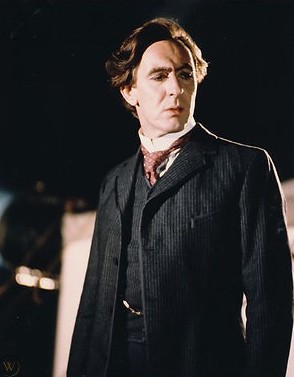
Cabinet of Dr. Caligari - Conrad Veidt, Lil Dagover
World War I ended on November 11, 1918. In that time there were over 40 million military and civilian casualties, and 20 million deaths –influenza finished the job that man’s wars had started.
The “Spanish” flu was a murderous rage of a disease and the most deadly EVER.


Spanish Influenza weakened and killed the German army before surrender and the virulent flu conflagration flamed on, attacking the rest of the German population. (it is thought four million Germans died through war and contagion). Weakened and devastated by 4 years of war, they were ripe victims for disease – 436,600 Germans died in 1918-19 of influenza (in the end, the Spanish Flu killed many more people than WWI. Horrifically, it targeted 15-34 year-olds with healthy immune systems, perversely triggering a cytokine storm of white blood cells that ended up killing instead of curing.
There were 50 to 100 million deaths worldwide from 2 waves of the disease (there were later waves but they were much less lethal). The first in the spring was much less severe than the second which came in the fall of 1918. Young soldiers were perfect subjects and they were all returning home – spreading the disease everywhere they traveled.
675,000 were killed in the United States, the disease spread by returning soldiers (the US life expectancy was lowered 12 years as a result - the cities and towns that did best were the ones that told their citizens the truth and enforced the ban on going out in public).

In Germany, food was in short supply. People were already malnourished and returning soldiers were wounded and ill. There wasn’t enough housing available for them as much had been destroyed in the bombings. Many soldiers who had been spared during the battle, died from the flu on their return home.


To protest the conditions, Rosa Luxemburg’s Spartacist League rose up against the new government in 1919 and there were riots. It was called the Spartacist Uprising (for the roman slave, Spartacus).


During this time Germany became a republic and there was a tectonic shift in their world – their national identity was changed with the new order and Expressionism was the ideal visual language for the day-- manifesting the internal conflicts of the German people in art and film. The carpe diem spirit of the young had a decidedly darker interpretation in Germany as seen in a popular song of the day, Fox Macabre:

Berlin - your dancer is death!
Berlin - stop, you are in need!
From strike to strike, from rip to rip
With murder and naked dance and with the step
You have to keep enjoying yourself! (full lyrics HERE)
The artists of 1919 Germany were exhausted by war and death and struck out through their art – tormented and polluted by the horrors they had witnessed.

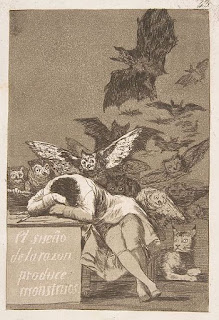
Goya’s Capricho No. 43 reads; “The sleep/dream of reason produces monsters", but this was distilled from his original thought, "Fantasy abandoned by reason produces impossible monsters: united with her (reason), she (fantasy) is the mother of the arts and the origin of their marvels."

The cinematic results of these 1919 dreams were bold, febrile, new and brilliant.
My favorite German Expressionist films are the earliest – The Cabinet of Dr. Caligari , the lost classic, Algol. Tragödie der Macht, From Morn to Midnight and Genuine, Tragedy of the Vampire – all from 1920. (Criterion Channel has a diabolical collection of first-rate prints of many German Expressionist classics– it’s the first time I’ve seen such a gorgeous version of Caligari and it is divine (the rest on the list are not on Criterion but are online in varying quality).


With little money for expensive sets, legendary Der Sturm Magazine's alumnus became Caligari’s art directors.


Cabinet of Dr. Caligari is the tale of a hypnotist and a murderous somnambulist the doctor kept in his thrall. It was directed by Robert Wiene who hired the team (judging from his oeuvre, Weine was not the visual master behind the form his artists created). The artists, Hermann Warm, Walter Reimann and Walter Röhrig, went to work creating their own elaborately crafted reality with paint, plaster and a divine, malevolent architectural geometry with no right angles. It is the stuff of nightmares uncoupled from familiar physical reality of rooms and roads.


Just after doing Caligari, art director Walter Reimann began Algol. Tragödie der Macht in 1920 – the story of an unlimited power source from an alien civilization and the invention of a dead scientist who found a way to harness the power. The film was lost for nearly 100 years but now is available– alas only with poor prints. Stefan Drössler of Filmmuseum which is working on restoring the film said Reimann was responsible for, “the entire artistic and decorative aspects of the film” through “the supervision and finalizing of the décor”, all the way to “the setting up of the studio sets” and “the creation of the titles”. The film isn’t saturated with expressionism as Caligari so the effect isn’t as disturbing – but the techniques are used effectively – creating the mad world of unlimited power contrasted with the provincial earthy reality of the worker’s world.




Wiene also directed Genuine, Tragedy of a Vampire and enlisted another group of artists as art directors led by artist and designer César Klein, a founder of the November Group (Novembergruppe) of Expressionists– named after the month the German revolution occured. Klein was also a member of the Arbeitsrat für Kunst - the worker’s art’s council. Bernhard Klein worked with his brother César and helped to paint the sets (and later became an early animator).


From Morn to Midnight was the first film for expressionist theatre director, Karl Heinz Martin. It had art direction by Robert Neppach, a brilliant architect who ended up killing himself and his Jewish wife as WWII began. It used the same, full immersion into a mad, graphic, expressionist world as seen in Caligari but used to illustrate a fairly pedestrian story of obsession, theft, greed and redemption – the visuals make the story more compelling and unnerving. Like Caligari, From Morn to Midnight was an immersive visual experience from beginning to end.


This divine madness burned itself out in a single year, after its cathartic first burst of expressionism. The films that followed owed a debt to these first films but took their own path into a different, but equally disturbing realism with limited harrowing visits into unstable visual madness – but not the full immersion of 1920 (save in a few horror films). It was such a short and glorious blaze.
675,000 were killed in the United States, the disease spread by returning soldiers (the US life expectancy was lowered 12 years as a result - the cities and towns that did best were the ones that told their citizens the truth and enforced the ban on going out in public).

In Germany, food was in short supply. People were already malnourished and returning soldiers were wounded and ill. There wasn’t enough housing available for them as much had been destroyed in the bombings. Many soldiers who had been spared during the battle, died from the flu on their return home.


Fox Macabre ( Listen)
Berlin - your dancer is death!
Berlin - stop, you are in need!
From strike to strike, from rip to rip
With murder and naked dance and with the step
You have to keep enjoying yourself! (full lyrics HERE)
The artists of 1919 Germany were exhausted by war and death and struck out through their art – tormented and polluted by the horrors they had witnessed.
I thought of one of my favorite works of Goya as I read various manifestos of the day-- full of anxiety over the state of things (there was even a film called Nerves - Nerven about the condition).


–– monsters release creativity.
It was not a surprise that the artists of the day would stew up quite a brew from the crucible of death, destruction and disease they had just been through. It was an eruption – a vomit of anti-realism that was the stuff of nightmares. – an emotional interpretation of reality from both distorted and disorienting psychic and physical structures.

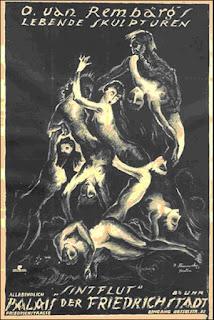
Living sculptures

sebastian droste/ anita berber
The cinematic results of these 1919 dreams were bold, febrile, new and brilliant.
My favorite German Expressionist films are the earliest – The Cabinet of Dr. Caligari , the lost classic, Algol. Tragödie der Macht, From Morn to Midnight and Genuine, Tragedy of the Vampire – all from 1920. (Criterion Channel has a diabolical collection of first-rate prints of many German Expressionist classics– it’s the first time I’ve seen such a gorgeous version of Caligari and it is divine (the rest on the list are not on Criterion but are online in varying quality).


brilliant poster by Josef Fenneker

The Marmorhaus theater in Berlin –
With little money for expensive sets, legendary Der Sturm Magazine's alumnus became Caligari’s art directors.


Der Sturm 1919


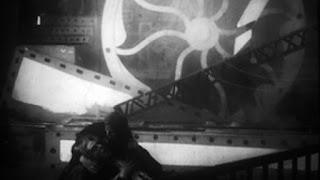
the magical machine that translated alien energy


This time in history has been much on my mind as we wait for Covid-19 to stampede through our hospital system. Although we are not already reeling from ‘the war to end all wars’, we are afraid and angry. Will we create a new art from the ashes of our pain and discontent?
I hope you enjoyed my dark tour -- now, more than ever, we need a break. Isolation is easier with great films and comfort food.
One of my favorite comfort foods these days isn’t my usual style – it’s modern for one –– a chili, chicken and cheese Korean/American hybrid dish from a blogger named Maangchi that I found in Sam Sifton’s NYTs Cooking section (you can watch Maangchi’s video HERE).
I am over the moon about it and have made it relentlessly. The sweet hot chicken with gooey cheese is perfect comfort food. Put it over rice or pasta or dunk into it with bread or crackers. I skipped the rice cake addition and changed proportions a bit to my taste. I imagine if you are vegetarian, just make it the sauce or use seitan. Try it. Feel better.

Cheese Buldak
¼ cup gochujang (Korean red-pepper paste)
2 tablespoons gochugaru (Korean red pepper flakes)
1 tablespoon light brown sugar
3 cloves garlic, peeled and minced (about 2 tablespoons)
1 (1-inch) piece ginger, peeled and minced (about 1 tablespoon)
1 tablespoon soy sauce
½ teaspoon freshly ground black pepper
1-pound boneless, skinless chicken thighs, cut into ¾” cubes
2 tablespoons neutral oil
6 to 8 ounces mozzarella, thinly sliced
2 scallions, sliced, for garnish if you like
Combine the gochugaru, gochujang, brown sugar, garlic, ginger, soy
sauce and black pepper in a medium bowl and mix well. Add the
chicken and stir until it is well coated.
Add the chicken mixture to the pan along with ¼ cup water. Cover
and cook over medium-high heat, stirring occasionally, until the
chicken is cooked through, 8 to 10 minutes. Meanwhile, heat the broiler in your oven.
Remove the chicken from the heat. Cover the pan with the sliced
mozzarella, then slide the pan under the broiler. Cook until the cheese
has melted and browned in spots, about 2 minutes. Remove from the
oven, and sprinkle with scallions. Serve immediately, with rice, pasta or bread.